
Introduction
Understanding the Medical Billing Process is essential for healthcare providers, medical practices, hospitals, clinics, and billing professionals throughout the United States. Medical billing is the foundation of healthcare revenue generation and plays a critical role in ensuring providers receive accurate and timely reimbursement for services rendered.
At RevCore Medical, we specialize in helping healthcare organizations optimize every stage of the billing cycle through comprehensive Revenue Cycle Management (RCM), Medical Coding, AR Management, Eligibility Verification, Prior Authorization, Provider Credentialing, Medical Billing Audits, and Dental Billing services.
This guide provides a complete overview of the Medical Billing and highlights why each stage is essential for maintaining a healthy revenue cycle.
What is Medical Billing?
Before diving into the Medical Billing, it is important to understand medical billing itself.
Medical billing is the process of translating healthcare services into billing claims submitted to insurance companies and patients for reimbursement. The process involves documentation review, coding, claim generation, submission, payment posting, denial management, and collections.
An efficient billing process helps healthcare organizations:
- Improve cash flow
- Reduce claim denials
- Increase reimbursement rates
- Maintain compliance
- Enhance operational efficiency
- Improve patient satisfaction
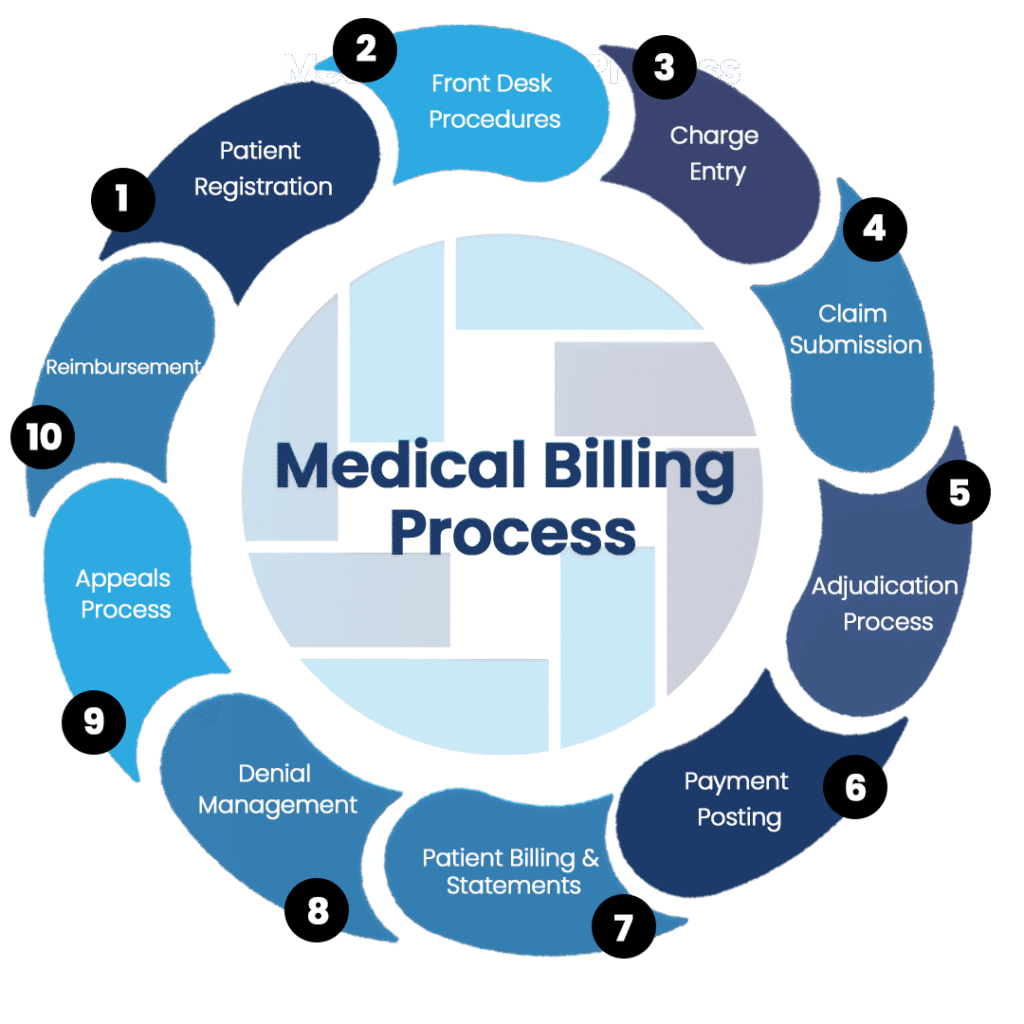
Medical Billing Process Explained Step by Step
The Medical Billing consists of multiple stages that work together to create an effective healthcare revenue cycle.
Step 1: Patient Registration
The first stage of the Medical Billing begins when a patient schedules an appointment.
Information collected includes:
- Patient demographics
- Insurance information
- Contact details
- Medical history
- Identification documents
Accurate registration reduces billing errors later in the process.
Step 2: Insurance Eligibility Verification
Insurance verification is one of the most critical stages in the Medical Billing.
Verification includes:
- Active coverage confirmation
- Policy validation
- Copayment verification
- Deductible review
- Benefit investigation
Eligibility Verification helps prevent claim rejections and payment delays.
Step 3: Prior Authorization
Many treatments and procedures require payer approval before services are performed.
The Prior Authorization process includes:
- Authorization requests
- Clinical documentation submission
- Insurance communication
- Approval tracking
Proper authorization reduces denied claims and reimbursement issues.
Step 4: Medical Documentation
Accurate documentation is essential in the Medical Billing Process.
Healthcare providers document:
- Diagnoses
- Treatments
- Procedures
- Medical necessity
- Patient encounters
Detailed documentation supports proper coding and claim accuracy.
Step 5: Medical Coding
Medical Coding converts healthcare services into standardized codes.
Common coding systems include:
- ICD-10 Codes
- CPT Codes
- HCPCS Codes
Accurate coding directly impacts reimbursement and compliance.
At RevCore Medical, certified coding professionals help ensure coding accuracy and claim integrity.
Step 6: Charge Capture
Charge capture is another important stage in the Medical Billing Process.
This process involves:
- Recording services rendered
- Assigning charges
- Validating billable procedures
- Reviewing documentation
Proper charge capture prevents revenue leakage and missed billing opportunities.
Step 7: Claim Creation
Once coding and charges are finalized, claims are generated.
Claims include:
- Patient information
- Provider information
- Insurance details
- Procedure codes
- Diagnosis codes
- Billing charges
Accurate claim creation improves first-pass acceptance rates.
Step 8: Claim Submission
Claim submission is a major component of the Medical Billing Process.
Claims are submitted electronically through clearinghouses to insurance payers.
Benefits include:
- Faster processing
- Reduced manual errors
- Improved claim tracking
- Faster reimbursement cycles
Electronic claims have become the standard across the United States healthcare industry.
Step 9: Claim Adjudication
After submission, insurance companies review claims.
The adjudication process determines:
- Approved claims
- Denied claims
- Partial payments
- Request for additional information
Payers evaluate coverage rules, medical necessity, coding accuracy, and policy requirements.
Step 10: Payment Posting
Payment posting records insurance reimbursements and patient payments.
This step includes:
- Electronic Remittance Advice (ERA)
- Explanation of Benefits (EOB)
- Payment reconciliation
- Account updates
Accurate posting ensures proper financial reporting.
Step 11: Denial Management
Denied claims are common within the Medical Billing Process.
Denial management includes:
- Root cause analysis
- Claim corrections
- Appeals processing
- Resubmission
Effective denial management significantly improves collection rates.
Step 12: Accounts Receivable Management
AR Management focuses on collecting outstanding balances.
Activities include:
- Insurance follow-up
- Patient collections
- Aging report review
- Revenue recovery
Reducing AR days improves cash flow and overall financial performance.
Step 13: Patient Billing
When insurance payments are finalized, remaining balances are billed to patients.
Patient billing includes:
- Statements
- Payment plans
- Collection notices
- Balance reconciliation
Transparent billing improves patient satisfaction and payment compliance.
Common Challenges in Medical Billing
Despite having a structured Medical Billing, healthcare organizations often face challenges.
Common issues include:
- Coding errors
- Missing documentation
- Eligibility issues
- Authorization delays
- Claim denials
- Payment delays
- Compliance concerns
Addressing these issues requires experienced billing professionals and proven workflows.

Services Offered by RevCore Medical
RevCore Medical provides complete healthcare revenue solutions beyond the Medical Billing.
Our services include:
Revenue Cycle Management
End-to-end financial workflow management.
Medical Billing
Accurate claim submission and reimbursement support.
Medical Coding
ICD-10, CPT, and HCPCS coding services.
AR Management
Recovery of unpaid and aging claims.
Eligibility Verification
Insurance coverage validation.
Prior Authorization
Authorization management and tracking.
Provider Credentialing
Insurance enrollment and payer credentialing.
Medical Billing Audit
Revenue leakage detection and compliance review.
Dental Billing
Specialized billing solutions for dental practices.
Benefits of an Optimized Medical Billing Process
A well-managed Medical Billing offers numerous benefits.
Financial Benefits
- Increased collections
- Reduced denials
- Faster reimbursements
- Improved cash flow
Operational Benefits
- Reduced administrative burden
- Improved efficiency
- Better reporting
- Enhanced compliance
Patient Benefits
- Clear billing communication
- Accurate statements
- Improved satisfaction
Service Areas Across the United States
RevCore Medical proudly serves healthcare providers nationwide. Our major service areas include New York City, Los Angeles, Chicago, Houston, Dallas, Phoenix, Philadelphia, San Antonio, San Diego, San Jose, Austin, Jacksonville, Fort Worth, Columbus, Charlotte, Indianapolis, Seattle, Denver, Boston, Nashville, Atlanta, Miami, Orlando, Tampa, Las Vegas, Sacramento, Minneapolis, Kansas City, and Washington, D.C. We also support suburban and rural healthcare organizations throughout the United States.
Why Choose RevCore Medical?
Healthcare providers choose RevCore Medical because of our:
- Industry expertise
- Certified professionals
- End-to-end service solutions
- Nationwide coverage
- Transparent reporting
- Customized billing strategies
- Revenue-focused approach
Our team works to maximize reimbursement while minimizing administrative challenges.
Frequently Asked Questions (FAQs)
What is the medical billing process?
It is the complete cycle of submitting and managing healthcare claims for reimbursement.
Why is eligibility verification important?
It prevents claim denials and confirms insurance coverage.
What role does medical coding play?
Coding translates diagnoses and procedures into billable codes.
What is denial management?
The process of correcting and resubmitting denied claims.
5. What is AR Management?
Accounts Receivable Management focuses on collecting unpaid claims.
How long does claim processing take?
Processing times vary by payer and claim complexity.
Can outsourcing medical billing improve revenue?
Yes, professional billing services often improve collections and reduce denials.
Does RevCore Medical provide nationwide services?
Yes, we serve healthcare providers across the United States.
What is a medical billing audit?
A review process used to identify billing errors and revenue leakage.
What services does RevCore Medical offer?
RCM, Billing, Coding, Credentialing, AR Management, Eligibility Verification, Prior Authorization, Audits, and Dental Billing.
Get Started with RevCore Medical
An efficient Medical Billing Process can significantly improve your practice’s financial performance. RevCore Medical provides comprehensive healthcare revenue solutions designed to maximize collections, reduce denials, and streamline operations.
Request Your Free Billing Analysis Today
✔ Improve Cash Flow
✔ Reduce Claim Denials
✔ Accelerate Reimbursements
✔ Optimize Revenue Cycle Performance
✔ Strengthen Financial Stability
RevCore Medical – Your Trusted Medical Billing and Revenue Cycle Management Partner Across the United States.