
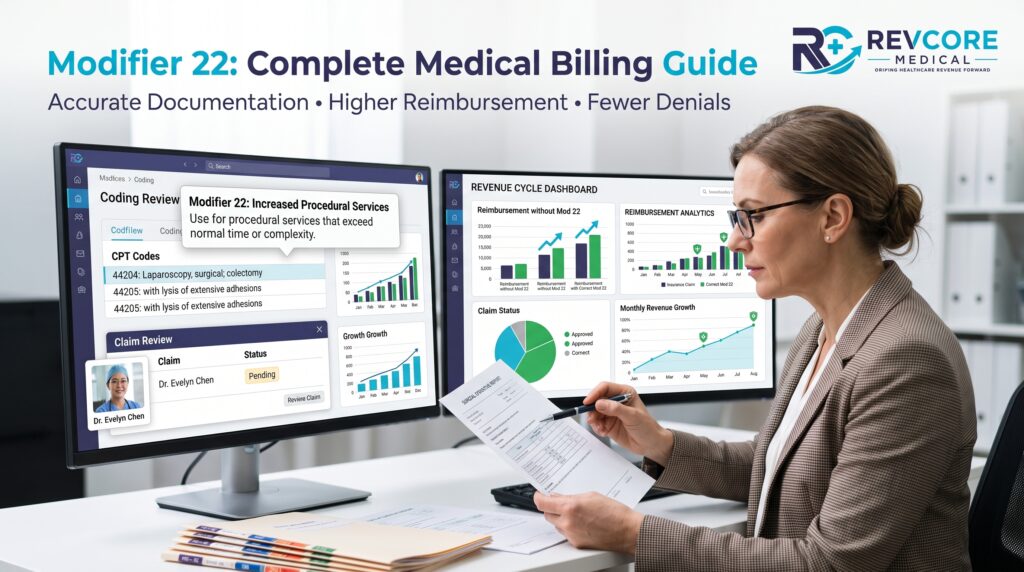
Everything Healthcare Providers Need to Know About Modifier 22
Modifier 22 is one of the most important CPT modifiers used in medical billing. It allows healthcare providers to report that a procedure required substantially greater work than typically expected. When applied correctly with proper documentation, Modifier 22 can help providers receive additional reimbursement for unusually complex procedures while maintaining compliance with payer guidelines.
At RevCore Medical, we help healthcare providers throughout the United States maximize reimbursement through accurate Medical Billing, Medical Coding, Revenue Cycle Management, Provider Credentialing, Prior Authorization, Eligibility Verification, AR Management, Medical Billing Audits, and No Cost Billing Analysis. Our experienced billing and coding specialists understand the correct use of Modifier 22 and help practices reduce denials while optimizing revenue.
This comprehensive guide explains Modifier 22, when it should be used, documentation requirements, reimbursement considerations, common mistakes, and best practices for successful claim submission.
What is Modifier 22?
Modifier 22 is a CPT modifier used to indicate that the physician’s work required to complete a procedure was significantly greater than what is normally expected.
The additional work must involve substantial extra physician effort rather than routine complexity.
Healthcare providers may report Modifier when procedures require:
- Increased surgical complexity
- Extensive scar tissue
- Unexpected anatomical variations
- Significant trauma
- Severe infection
- Increased physician time
- Additional technical difficulty
- Unusual operative circumstances
The purpose of Modifier is to inform insurance payers that additional reimbursement may be appropriate because the procedure exceeded the typical level of work.
Why Modifier 22 is Important
Accurate use of Modifier benefits both healthcare providers and the reimbursement process.
Proper application helps:
- Improve reimbursement accuracy
- Reduce underpayment
- Support fair physician compensation
- Document increased procedural complexity
- Strengthen billing compliance
- Reduce unnecessary claim appeals
- Improve Revenue Cycle Management
- Support accurate medical documentation
Without proper reporting, providers may receive payment only for a standard procedure despite significantly increased physician effort.
When Should Modifier 22 Be Used?
Modifier should only be reported when the physician performs work that is substantially greater than normally required for the billed procedure.
Situations that may justify Modifier include:
Unusual Surgical Complexity
Procedures involving exceptional technical difficulty due to patient anatomy or disease severity.
Extensive Scar Tissue
Operations requiring significant additional dissection because of previous surgeries or dense adhesions.
Severe Trauma
Complex injuries that require extensive reconstruction or additional operative work beyond routine expectations.
Unexpected Findings During Surgery
Previously unknown medical conditions identified during the procedure that require substantially more physician effort.
Complex Disease Progression
Advanced disease processes requiring additional surgical skill, planning, and operative time.
Significant Bleeding Control
Cases involving unusual blood loss requiring extensive management beyond standard surgical expectations.
The additional work must always be documented clearly and completely.
When Modifier 22 Should NOT Be Used
Not every difficult procedure qualifies for Modifier.
It should not be reported for:
- Routine surgical difficulty
- Standard obesity without increased procedural complexity
- Minor increases in operative time
- Typical patient variations
- Procedures already described by another CPT code
- Services reported using incorrect CPT coding
- Inadequate physician documentation
Using Modifier 22 improperly increases the likelihood of claim denials and payer audits.
Documentation Requirements for Modifier 22
Comprehensive documentation is the most important factor in receiving additional reimbursement for Modifier.
Medical records should include:
- Detailed operative report
- Description of unusual circumstances
- Explanation of increased physician effort
- Medical necessity
- Additional operative time
- Technical challenges encountered
- Complexity of the patient’s condition
- Clinical findings supporting increased work
Clear documentation allows insurance companies to determine whether additional reimbursement is justified.
Information That Should Be Included in the Operative Report
When reporting Modifier, physicians should clearly document:
- Why the procedure was unusually difficult
- What additional work was required
- How the patient’s condition increased complexity
- Why the procedure exceeded normal expectations
- The additional physician time involved
- Clinical factors supporting the modifier
A complete operative report significantly improves claim review and reimbursement decisions.
How Insurance Companies Review Modifier 22 Claims
Insurance payers carefully evaluate every claim submitted with Modifier.
Their review typically considers:
- CPT procedure code
- Operative report
- Physician documentation
- Medical necessity
- Clinical complexity
- Additional physician work
- Time required
- Payer-specific reimbursement policies
Because Modifier requests additional reimbursement, documentation standards are considerably higher than standard claims.
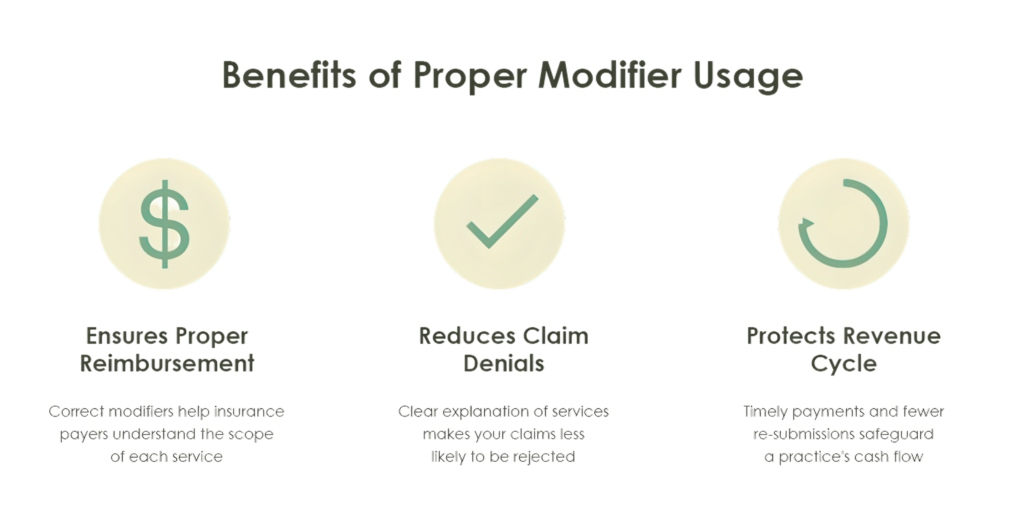
Benefits of Proper Modifier 22 Reporting
Correct use of Modifier provides several financial and operational advantages.
Benefits include:
- Higher reimbursement opportunities
- Improved claim accuracy
- Reduced payment disputes
- Better documentation quality
- Stronger compliance
- Improved Revenue Cycle Management
- Better physician compensation
- Reduced revenue loss
Healthcare providers who understand proper modifier usage improve overall financial performance.
Common Documentation Challenges
Many Modifier claims are denied because documentation does not adequately support the additional work performed.
Common issues include:
- Incomplete operative reports
- Missing explanation of increased complexity
- Insufficient clinical detail
- Lack of medical necessity
- Poor physician documentation
- Incorrect modifier usage
- Missing supporting records
- Inconsistent coding
Professional Medical Coding and Medical Billing teams help minimize these issues before claims are submitted.
How RevCore Medical Supports Accurate Modifier 22 Billing
At RevCore Medical, our experienced billing and coding professionals ensure that Modifier claims are properly documented, coded, and submitted according to payer requirements.
Our services include:
- Medical Billing
- Medical Coding
- Revenue Cycle Management
- Provider Credentialing
- Prior Authorization
- Eligibility Verification
- AR Management
- Medical Billing Audits
- No Cost Billing Analysis
By combining accurate coding with complete documentation review, we help healthcare providers maximize reimbursement while reducing denials and administrative burden.
Best Practices for Using Modifier 22
Submitting Modifier successfully requires accurate coding, detailed documentation, and compliance with payer guidelines. Following established best practices improves reimbursement opportunities while reducing denials.
Healthcare providers should:
- Apply Modifier only when physician work is substantially greater than normal.
- Include a detailed operative report with every claim.
- Clearly explain why additional physician effort was required.
- Document increased operative time and technical difficulty.
- Support the claim with complete clinical documentation.
- Verify payer-specific requirements before submission.
- Conduct coding audits to ensure compliance.
- Monitor claim outcomes and denial trends.
- Review annual CPT coding updates.
- Train providers and coding staff on proper modifier usage.
Consistent documentation and coding standards strengthen claim accuracy and improve Revenue Cycle Management.

Common Modifier 22 Billing Mistakes to Avoid
Many claims submitted with Modifier are delayed or denied because of avoidable errors.
Common mistakes include:
- Using Modifier for routine surgical difficulty.
- Submitting incomplete operative reports.
- Failing to explain the increased physician work.
- Applying the modifier to procedures that do not qualify.
- Using outdated CPT codes.
- Omitting supporting clinical documentation.
- Ignoring payer-specific billing policies.
- Incorrect code selection.
- Poor communication between providers and coding staff.
- Inadequate documentation of medical necessity.
Avoiding these issues helps healthcare providers improve reimbursement and reduce administrative rework.
Documentation Tips for Successful Modifier 22 Claims
Documentation is the deciding factor in whether additional reimbursement is approved.
A complete record should include:
- Comprehensive operative notes
- Detailed description of unusual circumstances
- Reason for increased physician effort
- Clinical findings
- Medical necessity
- Additional operative time
- Technical challenges encountered
- Surgical complexity
- Any unexpected findings affecting the procedure
High-quality documentation strengthens claim review and supports appropriate reimbursement.
Why Outsource Medical Billing and Coding?
Managing complex coding scenarios like Modifier 22 requires specialized expertise. Outsourcing Medical Billing and Medical Coding to experienced professionals reduces administrative burden while improving reimbursement accuracy.
Benefits of outsourcing include:
- Certified coding professionals
- Improved coding accuracy
- Reduced claim denials
- Faster claim submission
- Better payer compliance
- Increased clean claim rates
- Improved cash flow
- Reduced administrative costs
- Comprehensive Revenue Cycle Management
- Access to experienced reimbursement specialists
RevCore Medical provides customized billing and coding solutions designed to maximize practice revenue.
Why Choose RevCore Medical?
RevCore Medical is committed to helping healthcare providers optimize reimbursement through complete Revenue Cycle Management services.
Our comprehensive solutions include:
- Revenue Cycle Management
- Medical Billing
- Medical Coding
- Provider Credentialing
- Prior Authorization
- Eligibility Verification
- AR Management
- Medical Billing Audits
- No Cost Billing Analysis
Our experienced professionals ensure coding accuracy, timely claim submission, and proactive revenue optimization.
Healthcare Specialties We Serve
RevCore Medical proudly supports healthcare providers across a wide range of specialties, including:
- Family Medicine
- Internal Medicine
- General Surgery
- Orthopedic Surgery
- Neurosurgery
- Cardiology
- Gastroenterology
- Dermatology
- Urology
- Obstetrics & Gynecology
- Plastic Surgery
- Pain Management
- Radiology
- Urgent Care
- Behavioral Health
- Physical Therapy
- Chiropractic Care
- Multi-Specialty Clinics
Each specialty has unique coding requirements, and our certified billing professionals ensure accurate modifier usage based on payer guidelines.
Major Service Areas Across the United States
RevCore Medical proudly provides Medical Billing, Medical Coding, and Revenue Cycle Management services throughout the United States. We support healthcare providers in New York City, Los Angeles, Chicago, Houston, Dallas, Phoenix, Philadelphia, San Antonio, San Diego, San Jose, Austin, Jacksonville, Fort Worth, Columbus, Charlotte, Indianapolis, Seattle, Denver, Boston, Nashville, Atlanta, Miami, Orlando, Tampa, Las Vegas, Sacramento, Minneapolis, Kansas City, Washington, D.C., Baltimore, Portland, Salt Lake City, Raleigh, Cleveland, Detroit, Cincinnati, St. Louis, Pittsburgh, and surrounding metropolitan communities. We also partner with healthcare organizations in suburban and rural areas nationwide.
Frequently Asked Questions
What is Modifier 22?
Modifier 22 is a CPT modifier indicating that a procedure required substantially greater physician work than normally expected.
When should Modifier 22 be used?
It should only be used when a procedure involves significantly increased complexity, time, or physician effort beyond the typical service.
Does Modifier 22 increase reimbursement?
It may. Insurance companies review documentation to determine whether additional reimbursement is justified.
What documentation is required for Modifier 22?
Providers should include a detailed operative report explaining the additional work, medical necessity, increased complexity, and extra physician effort.
Why are Modifier 22 claims denied?
Common reasons include insufficient documentation, incorrect modifier usage, lack of medical necessity, and failure to meet payer requirements.
Can Modifier 22 be used on every surgical procedure?
No. It should only be reported when the physician’s work is substantially greater than normally required.
How does RevCore Medical help with Modifier 22 claims?
We review documentation, ensure accurate coding, verify payer requirements, and submit clean claims to maximize reimbursement.
What other services does RevCore Medical provide?
Our services include Revenue Cycle Management, Medical Billing, Medical Coding, Provider Credentialing, Prior Authorization, Eligibility Verification, AR Management, Medical Billing Audits, and No Cost Billing Analysis.
Does RevCore Medical serve providers across the United States?
Yes. We provide nationwide Revenue Cycle Management solutions for healthcare providers of all sizes.
How can my practice get started?
Contact RevCore Medical today for a free consultation and a No Cost Billing Analysis to identify opportunities for improved reimbursement.
Maximize Reimbursement with RevCore Medical
Proper use of Modifier can significantly improve reimbursement for unusually complex procedures when supported by accurate documentation and coding. RevCore Medical helps healthcare providers reduce denials, strengthen compliance, and optimize financial performance through expert Medical Billing, Medical Coding, and complete Revenue Cycle Management solutions.
Whether your practice requires assistance with Modifier, Provider Credentialing, Prior Authorization, Eligibility Verification, AR Management, or complete Revenue Cycle Management, our experienced team is ready to help.
Request Your FREE No Cost Billing Analysis Today!
✔ Improve Coding Accuracy
✔ Reduce Claim Denials
✔ Maximize Insurance Reimbursements
✔ Strengthen Revenue Cycle Performance
✔ Increase Practice Profitability
RevCore Medical – Your Trusted Revenue Cycle Management Partner Across the United States.