

Surgical billing requires precise coding to ensure healthcare providers receive appropriate reimbursement for the services they perform. Among the many CPT modifiers used in medical billing, Modifier 54 plays a vital role in accurately reporting surgical care when the operating physician performs only the surgical procedure while another qualified provider manages preoperative or postoperative care. Proper application of Modifier 54 helps avoid claim denials, prevents duplicate billing, and ensures reimbursement reflects the services actually rendered.
Insurance companies, Medicare, and commercial payers closely review surgical claims that include Modifier because incorrect usage can result in payment delays, compliance concerns, and revenue loss. Understanding when Modifier should be appended, how documentation should support it, and which payer guidelines apply is essential for surgeons, physician groups, hospitals, ambulatory surgery centers, and medical billing teams.
At RevCore Medical, we specialize in helping healthcare providers across the United States improve reimbursement through comprehensive Revenue Cycle Management (RCM), Medical Billing, Medical Coding, Insurance Eligibility Verification, Prior Authorization, Provider Credentialing, Accounts Receivable (AR) Management, Denial Management, Medical Billing Audits, Dental Billing, and No Cost Billing Analysis. Our certified billing professionals ensure that Modifier 54 is reported accurately, documentation meets payer requirements, and surgical claims move through the reimbursement process efficiently.
This guide explains everything healthcare providers need to know about Modifier, including billing requirements, documentation standards, coding rules, common mistakes, and reimbursement best practices.
What is Modifier 54?
Modifier 54 is a CPT surgical modifier used to indicate that the physician performed only the surgical procedure and did not provide the routine preoperative or postoperative management associated with that surgery.
When Modifier 54 is appended to an eligible surgical CPT code, it informs the insurance payer that reimbursement should be limited to the intraoperative surgical portion of the global surgical package. The physician responsible for postoperative management or preoperative care may report separate services using the appropriate modifiers when permitted by payer policy.
Using Modifier 54 correctly ensures that reimbursement is allocated fairly among providers who share responsibility for the patient’s surgical care.
Why Modifier 54 is Important in Medical Billing
Accurate use of Modifier 54 improves transparency in surgical billing and ensures that healthcare providers are reimbursed only for the portion of care they personally delivered.
Proper reporting of Modifier 54 helps practices:
- Prevent duplicate reimbursement
- Improve surgical billing accuracy
- Comply with Medicare global surgery guidelines
- Reduce payer audits
- Minimize claim denials
- Strengthen coding compliance
- Improve clean claim rates
- Enhance Revenue Cycle Management performance
- Support accurate payment allocation
- Improve overall financial reporting
A standardized billing process for Modifier 54 also reduces administrative workload and supports more efficient claims management.
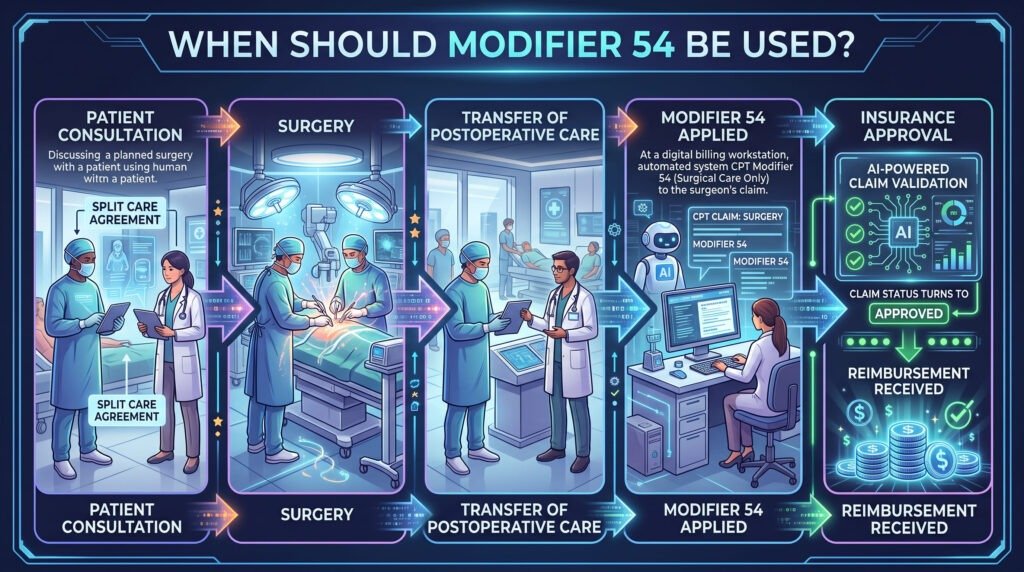
When Should Modifier 54 Be Used?
Modifier 54 should be reported only when a physician performs the surgical procedure but transfers all or part of the routine preoperative or postoperative management to another qualified healthcare professional.
Situations where Modifier 54 may be appropriate include:
- Surgical care performed by a specialist while postoperative management is transferred to another physician.
- Surgical procedures involving provider relocation after surgery.
- Patients requiring postoperative care in a different geographic location.
- Coordinated surgical care between multiple physician groups.
- Certain referral-based surgical arrangements permitted by payer policy.
The transfer of care must be documented clearly in the patient’s medical record, and all participating providers should maintain complete clinical documentation.
Documentation Requirements for Modifier 54
Successful reimbursement depends on thorough documentation supporting the use of Modifier 54. Medical records should clearly establish that only the surgical component of care was provided by the billing physician.
Essential documentation includes:
Surgical Documentation
- Operative report
- Procedure performed
- Date of surgery
- Surgical findings
- Technique used
- Complications, if any
- Physician signature
Transfer of Care Documentation
- Date of transfer
- Physician accepting postoperative care
- Written transfer agreement when required
- Clinical communication records
- Patient discharge instructions
Medical Necessity
Documentation should demonstrate:
- Medical necessity for the surgical procedure
- Appropriate diagnosis
- Supporting clinical findings
- Diagnostic testing
- Treatment plan
Complete documentation helps reduce reimbursement delays while supporting payer compliance.
Modifier 54 and the Global Surgical Package
One of the most important concepts associated with Modifier 54 is the global surgical package.
The global surgical package generally includes:
- Preoperative evaluation related to surgery
- Intraoperative surgical services
- Routine postoperative care
- Follow-up visits related to recovery
- Minor postoperative management
- Surgical decision-making included within global periods
When Modifier is reported, the physician is indicating responsibility only for the surgical portion of the global package. Preoperative and postoperative management may be billed separately by other qualified providers when permitted by payer rules.
Understanding global surgery rules is essential for accurate Modifier 54 reporting.
Modifier 54 vs. Modifier 55 vs. Modifier 56
Healthcare providers frequently confuse surgical care modifiers. Understanding the differences helps prevent incorrect claim submission.
| Modifier | Purpose |
|---|---|
| Modifier 54 | Surgical care only |
| Modifier 55 | Postoperative management only |
| Modifier 56 | Preoperative management only |
These modifiers are often used together when different physicians share responsibility for various portions of surgical care. Proper coordination and documentation ensure accurate reimbursement for each provider involved.
Surgical Specialties That Frequently Use Modifier 54
Several surgical specialties may appropriately report Modifier 54 when patient care is shared among multiple providers.
Common specialties include:
- General Surgery
- Orthopedic Surgery
- Neurosurgery
- Cardiothoracic Surgery
- Vascular Surgery
- Plastic Surgery
- Urology
- Gynecologic Surgery
- Ophthalmology
- Otolaryngology (ENT)
- Podiatric Surgery
- Trauma Surgery
Regardless of specialty, the use of Modifier 54 must always be supported by complete documentation and payer-specific billing guidelines.
Common Procedures That May Require Modifier 54
Depending on clinical circumstances and payer rules, Modifier 54 may be reported with eligible surgical procedures such as:
- Joint replacement surgery
- Fracture repair
- Spinal surgery
- Cataract surgery
- Hernia repair
- Gallbladder surgery
- Vascular procedures
- Tumor excision
- Cardiac surgery
- Reconstructive surgery
- Trauma surgery
- Orthopedic reconstruction
Before submitting claims, billing professionals should verify that the procedure is eligible for Modifier 54 under the applicable payer’s guidelines.
Billing Guidelines for Modifier 54
Accurate reporting of Modifier requires healthcare providers to understand global surgical package rules, payer-specific billing requirements, and proper transfer-of-care documentation. Because this modifier affects reimbursement allocation among multiple physicians, insurance carriers carefully review claims to verify that each provider billed only for the portion of care they delivered.
When submitting claims with Modifier, providers should follow these billing guidelines:
- Append Modifier only to eligible surgical CPT codes.
- Confirm that another qualified physician is responsible for preoperative or postoperative management.
- Clearly document the transfer of care in the patient’s medical record.
- Ensure the operative report supports the surgical service performed.
- Verify payer-specific rules before claim submission.
- Coordinate billing with physicians reporting Modifier 55 or Modifier 56.
- Submit claims using the correct diagnosis and CPT codes.
- Maintain complete documentation for audit purposes.
- Follow Medicare global surgery policies where applicable.
- Review reimbursement schedules before billing.
Following these billing guidelines helps reduce errors, improve reimbursement accuracy, and strengthen overall Revenue Cycle Management.
Common Billing Mistakes That Lead to Modifier 54 Claim Denials
Many claim denials involving Modifier 54 result from incomplete documentation or misunderstanding of global surgery rules. Even experienced providers can encounter reimbursement issues when modifier usage is not supported by the medical record.
Common mistakes include:
- Reporting Modifier 54 when the physician provided complete surgical care.
- Missing transfer-of-care documentation.
- Billing Modifier 54 on procedures that do not qualify.
- Failure to communicate with the physician providing postoperative care.
- Incorrect CPT code selection.
- Duplicate billing for the same surgical service.
- Missing operative reports.
- Incorrect global period calculations.
- Using Modifier 54 with Evaluation and Management services.
- Inconsistent documentation between providers.
- Failure to follow payer-specific billing requirements.
- Submitting incomplete insurance claims.
- Incorrect diagnosis coding.
- Missing physician signatures.
- Lack of medical necessity documentation.
Avoiding these common mistakes significantly improves first-pass claim acceptance.

Common Reasons Modifier 54 Claims Are Denied
Insurance companies review Modifier claims carefully because reimbursement is divided among multiple providers. Claims may be denied for several reasons, including documentation deficiencies and coding inaccuracies.
Frequent denial reasons include:
Incomplete Transfer of Care
Medical records fail to identify the physician responsible for postoperative management.
Insufficient Surgical Documentation
The operative report does not adequately support the billed surgical procedure.
Incorrect Modifier Usage
Modifier is reported when the surgeon actually provided postoperative care.
Duplicate Billing
Multiple physicians bill the entire global surgical package instead of their respective portions.
Missing Medical Necessity
Clinical documentation does not justify the surgical procedure.
Payer Policy Violations
Billing does not comply with Medicare or commercial payer guidelines.
Coding Errors
Incorrect CPT codes, diagnosis codes, or modifier combinations are submitted.
Documentation Conflicts
Medical records from participating providers contain inconsistent treatment information.
Proactively identifying these issues before claim submission helps minimize denials and accelerate reimbursement.

Best Practices for Accurate Modifier 54 Billing
Healthcare organizations that consistently achieve high clean-claim rates implement standardized workflows for reporting Modifier.
Recommended best practices include:
Verify Global Surgery Eligibility
Confirm that the surgical procedure falls within a global surgical package that permits reporting of Modifier 54.
Document Every Transfer of Care
Clearly identify:
- Physician transferring care
- Physician accepting care
- Date of transfer
- Reason for transfer
- Scope of postoperative management
Improve Surgical Documentation
Operative reports should include:
- Surgical indication
- Procedure performed
- Findings
- Surgical technique
- Complications
- Postoperative recommendations
Maintain Communication Between Providers
Effective coordination ensures documentation remains consistent throughout the patient’s surgical episode.
Conduct Internal Coding Audits
Routine billing audits help identify coding inconsistencies before claims reach insurance payers.
Monitor Denial Trends
Tracking denial patterns allows practices to improve documentation and reduce future reimbursement delays.
Stay Current with Coding Updates
Annual CPT revisions and payer policy changes can impact Modifier 54 billing requirements.
How Modifier 54 Supports Revenue Cycle Performance
Correct application of Modifier 54 contributes to stronger financial performance by ensuring surgical reimbursement accurately reflects the services each physician provides.
Benefits include:
- Higher clean claim rates
- Faster reimbursement
- Reduced administrative rework
- Lower denial percentages
- Improved coding accuracy
- Better compliance
- Accurate payment allocation
- Improved physician productivity
- Stronger Revenue Cycle Management
- Increased cash flow stability
Practices that implement structured modifier review processes often experience measurable improvements in billing efficiency and reimbursement consistency.
How RevCore Medical Helps Healthcare Providers
Managing surgical claims involving Modifier 54 requires experienced medical coders, knowledgeable billing professionals, and continuous monitoring of payer requirements. At RevCore Medical, we help healthcare providers across the United States simplify complex surgical billing while improving reimbursement accuracy.
Our comprehensive services include:
- Revenue Cycle Management (RCM)
- Medical Billing Services
- Medical Coding Services
- Surgical Billing Support
- Modifier 54 Documentation Review
- Insurance Eligibility Verification
- Prior Authorization
- Provider Credentialing
- Accounts Receivable (AR) Management
- Denial Management
- Medical Billing Audits
- Dental Billing
- No Cost Billing Analysis
Our dedicated billing specialists work proactively to reduce denials, improve coding accuracy, and optimize every stage of the reimbursement process.
Proudly Serving Healthcare Providers Across the United States
RevCore Medical proudly partners with physicians, hospitals, ambulatory surgery centers, specialty clinics, and multi-provider healthcare organizations nationwide. Our medical billing and Revenue Cycle Management solutions support providers in New York City, Los Angeles, Chicago, Houston, Phoenix, Philadelphia, San Antonio, San Diego, Dallas, Austin, Jacksonville, Fort Worth, Columbus, Charlotte, Indianapolis, Seattle, Denver, Boston, Nashville, Atlanta, Miami, Orlando, Tampa, Las Vegas, Sacramento, Minneapolis, Kansas City, Washington, D.C., Baltimore, Portland, Salt Lake City, Raleigh, Cleveland, Detroit, Cincinnati, St. Louis, Pittsburgh, and surrounding communities throughout the United States.
Whether your practice serves a major metropolitan area or a regional healthcare market, RevCore Medical delivers scalable billing solutions designed to improve financial performance and operational efficiency.
Frequently Asked Questions
What is Modifier 54 used for?
Modifier 54 indicates that a physician performed only the surgical portion of a procedure while another qualified provider manages the preoperative or postoperative care.
Can Modifier 54 be billed with every surgery?
No. Modifier 54 should only be reported for eligible surgical procedures when the surgical care is split among different healthcare providers according to payer guidelines.
Who reports Modifier 55 when Modifier 54 is used?
The physician responsible for postoperative management may report Modifier 55, subject to payer requirements and proper documentation.
Does Medicare recognize Modifier 54?
Yes. Medicare recognizes Modifier 54 for eligible surgical procedures when documentation supports a transfer of care and all billing requirements are met.
What documentation is required for Modifier 54?
Documentation should include the operative report, transfer-of-care details, physician communication, medical necessity, surgical findings, and appropriate signatures.
Can Modifier 54 reduce reimbursement delays?
Yes. Proper use of Modifier 54 with complete documentation helps reduce coding errors, prevent denials, and accelerate claim processing.
Is Modifier 54 used with office visits?
No. Modifier 54 applies only to eligible surgical procedures and should not be appended to Evaluation and Management (E/M) services.
Why are Modifier 54 claims audited?
Insurance carriers review these claims to confirm that reimbursement is correctly divided among physicians participating in the patient’s surgical care.
How often should surgical billing audits be performed?
Quarterly or monthly audits help identify documentation gaps, coding issues, and payer-specific compliance concerns before they affect reimbursement.
Why choose RevCore Medical for Modifier 54 billing?
RevCore Medical combines experienced medical coders, certified billing specialists, proactive denial management, comprehensive Revenue Cycle Management, and continuous compliance monitoring to maximize reimbursement while minimizing billing risk.
Optimize Surgical Billing with RevCore Medical
Accurate reporting of Modifier 54 is essential for proper reimbursement, reduced claim denials, and efficient surgical Revenue Cycle Management. Successful billing requires complete documentation, precise coding, and ongoing compliance with Medicare and commercial payer guidelines.
At RevCore Medical, we help healthcare providers nationwide streamline surgical billing through expert Medical Billing, Medical Coding, Revenue Cycle Management, Insurance Eligibility Verification, Prior Authorization, Provider Credentialing, Accounts Receivable Management, Denial Management, Medical Billing Audits, Dental Billing, and No Cost Billing Analysis.
Get Your FREE No Cost Billing Analysis Today!
Partner with RevCore Medical to:
- ✔ Improve Modifier 54 billing accuracy
- ✔ Reduce surgical claim denials
- ✔ Increase first-pass claim acceptance
- ✔ Accelerate insurance reimbursements
- ✔ Strengthen coding compliance
- ✔ Optimize Revenue Cycle Management
- ✔ Maximize your practice’s financial performance
RevCore Medical – Your Trusted Partner for Surgical Medical Billing and Revenue Cycle Management Across the United States.