
Accurate ICD-10-CM coding depends on understanding the clinical circumstances behind a patient’s condition. One area that frequently creates confusion is distinguishing recreational drug use from poisoning. While both involve exposure to drugs or other substances, they represent different medical situations and require different coding approaches.
Selecting the correct diagnosis code begins with careful review of the provider’s documentation. The patient’s intent, the amount of the substance used, and the resulting clinical effects all influence the final code assignment.
What is the Difference Between Recreational Drug Use and Poisoning?
Although these terms are sometimes used interchangeably, they have distinct meanings in ICD-10-CM coding.
Recreational Drug Use
Recreational drug use occurs when an individual intentionally consumes a substance to experience its psychoactive or physical effects. The decision to use the drug is voluntary, regardless of whether the outcome is expected or unexpected.
Examples include using cannabis, cocaine, ecstasy, or other substances for enjoyment, experimentation, or social purposes.
Poisoning
Poisoning occurs when exposure to a substance produces harmful or toxic effects on the body. The exposure may result from an accidental overdose, misuse of medication, intentional self-harm, or other circumstances that lead to toxicity.
It is important to understand that an overdose during recreational drug use is generally classified as poisoning under ICD-10-CM guidelines because the excessive amount of the substance produces toxic effects.
However, not every poisoning is related to recreational drug use. Poisoning may also occur due to:
- Accidental ingestion
- Medication errors
- Prescription drug overdoses
- Intentional self-harm
- Exposure to toxic chemicals or other harmful substances
For this reason, coders should never assume that recreational drug use and poisoning are synonymous.
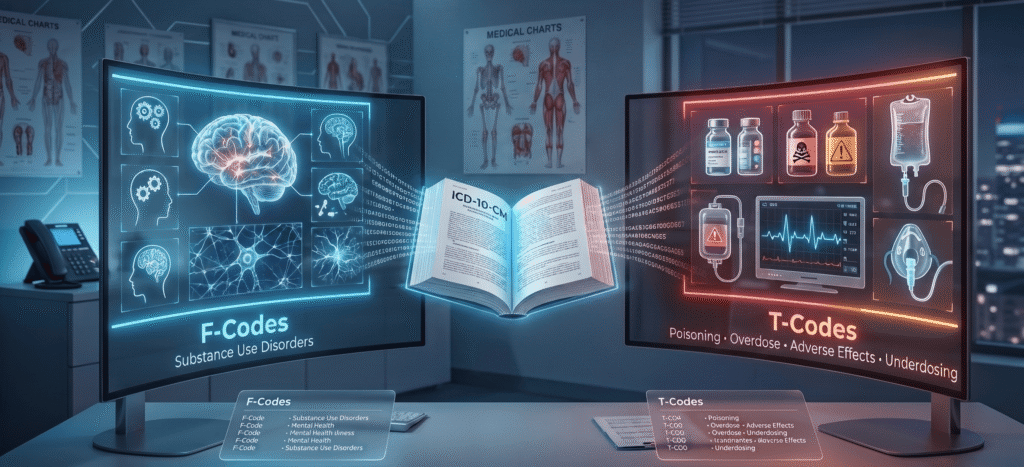
Understanding F-Codes and T-Codes
ICD-10-CM separates substance-related conditions into different ICD-10-CM Coding categories based on the patient’s diagnosis and clinical presentation.
F-Codes: Substance Use Disorders
F-Codes are assigned when the provider documents a diagnosable substance use disorder.
These codes identify conditions such as:
- Substance abuse
- Substance dependence
- Other documented substance-related disorders
An F-Code reflects an ongoing behavioral or psychological disorder rather than a single episode of substance use.
T-Codes: Poisoning and Toxic Effects
T-Codes describe the specific event involving the substance. These codes are used for:
- Poisoning
- Drug overdose
- Adverse effects of medications
- Underdosing
Unlike F-Codes, T-Codes do not indicate whether the patient has a substance use disorder. Instead, they describe the medical event that occurred during the encounter.
In certain situations, both an F-Code and a T-Code may be reported when documentation supports the presence of both a diagnosed substance use disorder and a poisoning event.
Why Complete Documentation Is Essential
Proper code assignment depends entirely on the provider’s documentation. Even when the same drug is involved, different clinical circumstances may require different ICD-10-CM codes.
Coders should carefully review documentation to determine:
- The patient’s intent
- The amount of the substance consumed
- The type of substance involved
- The circumstances surrounding exposure
- The patient’s symptoms and clinical findings
Incomplete documentation increases the risk of inaccurate ICD-10-CM Coding and may require clarification from the provider.
Questions Every Medical Coder Should Ask
What Was the Patient’s Intent?
Determine whether the substance was taken voluntarily for recreational purposes or whether the exposure was accidental, intentional for self-harm, or otherwise resulted in toxic effects.
Intent is often the deciding factor in code selection.
Was the Dose Excessive?
Evaluate whether the documented amount represents normal use or an excessive dose that resulted in toxicity or overdose.
Evidence of overdose typically supports poisoning codes.
Which Substance Was Involved?
Identify the substance responsible for the encounter. It may be:
An illicit drug
A prescription medication
An over-the-counter medication
A household chemical
Another toxic substance
Knowing the substance provides valuable icd 10 cm Coding context.
What Were the Circumstances of Exposure?
Review the medical record to understand how the exposure occurred.
Examples include:
Recreational use
Experimental use
Accidental ingestion
Medication misuse
Intentional overdose
The documented circumstances help determine the appropriate ICD-10-CM classification.
What Were the Clinical Effects?
Assess the patient’s symptoms and diagnosis to determine whether the exposure resulted in:
Toxicity
Poisoning
Adverse drug effects
Other medically significant complications
The clinical outcome should always support the selected diagnosis code.
Best Practices for Accurate ICD-10-CM Coding
To improve ICD-10-CM Coding accuracy, evaluate every case using the following framework:
- Confirm the patient’s intent.
- Review the dosage and determine whether an overdose occurred.
- Identify the specific substance involved.
- Understand the context of exposure.
- Assess the documented clinical findings before assigning codes.
When documentation does not clearly support code selection, the best practice is to submit a provider query rather than making assumptions.

Key Takeaways
Understanding the distinction between recreational drug use and poisoning is essential for compliant ICD-10-CM coding.
Remember these important points:
- Recreational drug use involves intentional consumption of a substance.
- Poisoning occurs when exposure produces harmful or toxic effects.
- Recreational overdoses are generally coded as poisoning.
- F-Codes identify diagnosed substance use disorders.
- T-Codes describe poisoning, overdose, adverse drug effects, and underdosing.
- Accurate documentation is the foundation of correct code selection.
- Reviewing intent, dose, substance, exposure, and clinical outcome helps ensure ICD-10-CM Coding accuracy.
By following these principles, medical coders can improve documentation integrity, reduce coding errors, and support accurate reimbursement while maintaining compliance with ICD-10-CM coding guidelines.