
Coding procedures performed within the cranial cavity is one of the more challenging areas of ICD-10-PCS coding. This guide explains the body part values, root operations, and ICD-10-PCS sections used for coding brain and cranial cavity procedures.
What Makes Cranial Cavity ICD-10-PCS Coding Complex?
Brain and cranial procedures may be reported using six different ICD-10-PCS sections:
- Medical and Surgical (Section 0)
- Administration (Section 3)
- Imaging (Section B)
- Nuclear Medicine (Section C)
- Radiation Therapy (Section D)
- New Technology (Section X)
Selecting the correct section depends on:
- The anatomical structure involved
- The intent of the procedure
- Whether radioactive materials or specialized devices are used
- The physician’s documentation
Medical and Surgical Section (0)
Within the Medical and Surgical section, cranial procedures are assigned to one of two body systems.
Central Nervous System and Cranial Nerves
Certain ICD-10-PCS tables include only general body part values such as:
- Brain
- Cranial Nerve
These values are used when:
- No more specific body part exists.
- Documentation does not identify a more detailed anatomical location.
Appendix D and Appendix E help coders identify the correct body part values.
Examples
Brain (0)
Includes:
- Encephalon
- Cerebrum
- Corpus Callosum
Cerebral Meninges (1)
Includes:
- Pia Mater
- Arachnoid Mater
- Leptomeninges
Cerebral Hemisphere (7)
Includes:
- Frontal Lobe
- Parietal Lobe
- Temporal Lobe
- Occipital Lobe
Cerebellum (C)
Includes the Culmen.
Coding Intracranial Dura Mater Spaces
Although the dura normally has no spaces, trauma or disease may create spaces filled with blood, cerebrospinal fluid, or pus.
The following body part values are commonly used with:
- Drainage
- Extirpation
- Fragmentation
Examples include:
- Epidural Space
- Subdural Space
- Subarachnoid Space
Coding Cranial Nerves
Brain nerves are divided into two categories.
Deep Brain Structures
Examples include:
- Basal Ganglia
- Thalamus
- Hypothalamus
- Cerebellum
Numbered Cranial Nerves
Each cranial nerve has its own ICD-10-PCS Coding body part value.
Examples include:
Vagus Nerve
The tenth cranial nerve extending through:
- Brain
- Neck
- Chest
- Abdomen
Accessory Nerve
The eleventh cranial nerve extending into the spinal region.
When a nerve branch lacks its own body part value, ICD-10-PCS Coding Guideline B4.2 instructs coders to report the closest proximal branch.
Example:
Procedures involving the mandibular branch are coded to the Trigeminal Nerve.
Anatomical Regions, General
Within this body system, Cranial Cavity is the only body part value for intracranial procedures.
Applicable root operations include:
- Drainage
- Extirpation
- Fragmentation
- Insertion
- Inspection
- Removal
- Revision
Brain Imaging Codes
Within the Imaging section, body part values include:
- Brain
- Cisterna
- Cerebral Ventricles
Root operations include:
- CT Scan
- MRI
- Ultrasonography
Nuclear Medicine Codes
Within Nuclear Medicine, body part values include:
- Brain
- Cerebrospinal Fluid
- Central Nervous System
Common procedures include:
- Planar Imaging
- Tomographic Imaging
- PET Imaging
- Non-Imaging Nuclear Medicine Probe
Radiation Therapy Codes
Radiation Therapy uses the Brain as the body part value.
Root operations include:
- Beam Radiation
- Brachytherapy
- Stereotactic Radiosurgery
- Other Radiation Procedures
New Technology Section (X)
Three body systems may apply.
Nervous System
Body part values include:
- Brain
- Vagus Nerve
- Prefrontal Cortex
Root operations include:
- Destruction
- Insertion
- Other Procedures
Anatomical Regions
Body Part:
- Cranial Cavity and Brain
Root Operation:
- Introduction
Physiological Systems
Body Part:
- Central Nervous System
Root Operations include:
- Monitoring
- Measurement
Coding Common Cranial Cavity Procedures
Burr Hole Procedures
A burr hole is created in the skull to:
- Relieve intracranial pressure
- Drain hematomas
- Drain abscesses
- Provide access for brain surgery
Because the burr hole represents a surgical approach rather than the actual procedure, coding depends on the primary purpose of the operation.
Applicable root operations include:
- Drainage
- Fragmentation
- Extirpation
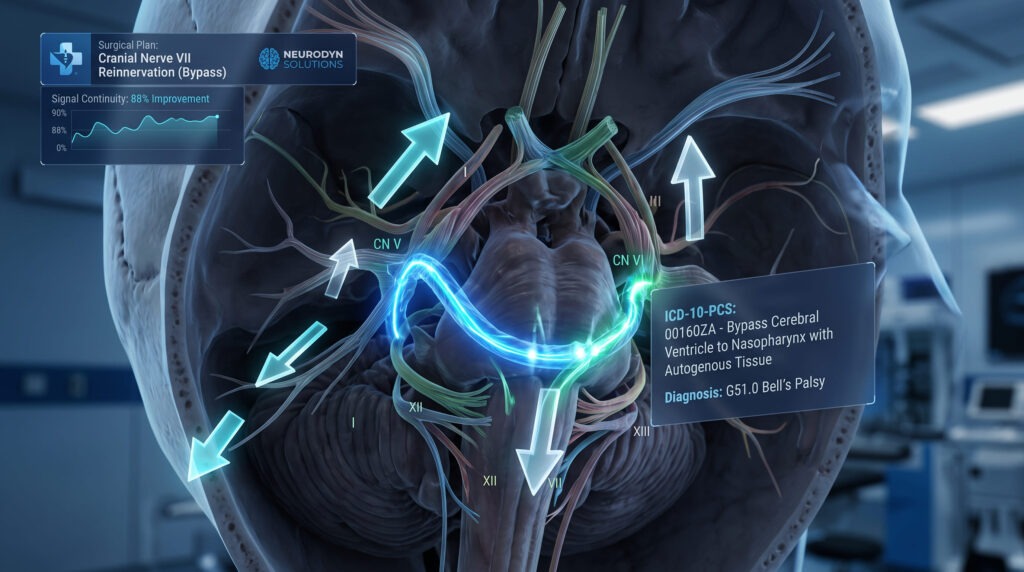
Coding Brain Nerve Bypass Procedures
Bypass procedures redirect nerve signals around damaged tissue to restore movement and sensation.
According to ICD-10-PCS Coding Guideline B3.6a, bypass coding requires identifying:
- The body part bypassed from
- The body part bypassed to
Possible qualifier values include:
- Nasopharynx
- Mastoid Sinus
- Atrium
- Blood Vessel
- Pleural Cavity
- Intestine
- Peritoneal Cavity
- Urinary Tract
- Bone Marrow
- Subgaleal Space
- Cerebral Cistern
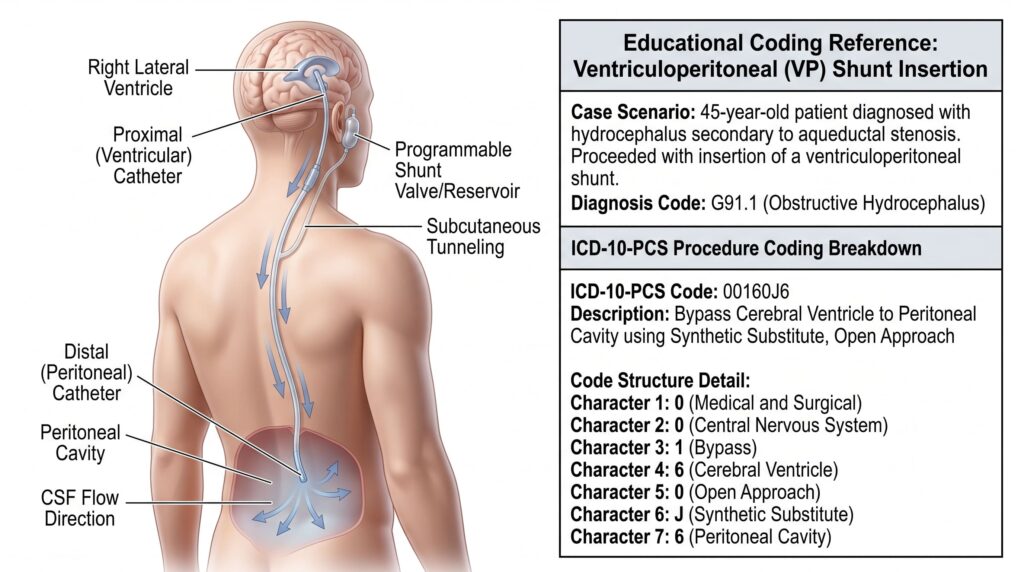
Coding Hydrocephalus Shunt Placement
Hydrocephalus shunt placement is classified as a bypass procedure.
A flexible shunt diverts excess cerebrospinal fluid from the brain ventricles to another body cavity, most commonly the abdomen, helping relieve increased intracranial pressure.
Coding Intracranial Dura Mater Spaces
Although the dura mater is a tough protective membrane surrounding the brain, certain medical conditions can create abnormal spaces between its layers. These spaces often become filled with blood, cerebrospinal fluid (CSF), or infectious material, requiring surgical intervention.
Common intracranial spaces include:
- Epidural Space
- Subdural Space
- Subarachnoid Space
Procedures performed within these areas frequently involve the following ICD-10-PCS Coding root operations:
- Drainage – Removing accumulated fluid or blood.
- Extirpation – Removing solid matter such as blood clots or foreign material.
- Fragmentation – Breaking solid matter into smaller pieces for removal.
Medical coders should review operative reports carefully to identify the exact anatomical location and physician intent before selecting the appropriate root operation.
Coding Cranial Nerve Procedures
The twelve cranial nerves control numerous sensory and motor functions throughout the body. Procedures involving these nerves require careful identification of the affected nerve and its documented anatomical location.
Examples include:
- Optic Nerve
- Trigeminal Nerve
- Facial Nerve
- Vestibulocochlear Nerve
- Glossopharyngeal Nerve
- Vagus Nerve
- Accessory Nerve
- Hypoglossal Nerve
When documentation specifies only a branch of a cranial nerve without an individual ICD-10-PCS Coding body part value, coders should follow the Official Coding Guidelines and assign the closest proximal nerve value supported by the documentation.
Accurate nerve identification is essential because each cranial nerve serves different physiological functions and may have unique body part values within ICD-10-PCS Coding.
Anatomical Regions and the Cranial Cavity
Some procedures involve the cranial cavity rather than a specific brain structure. In these cases, ICD-10-PCS Coding provides dedicated body part values under the Anatomical Regions body system.
Common root operations performed within the cranial cavity include:
- Drainage
- Inspection
- Removal
- Revision
- Insertion
- Extirpation
- Fragmentation
These procedures are frequently performed to relieve pressure, treat infections, remove foreign material, or revise previously implanted medical devices.
Imaging Procedures for Brain Disorders
Diagnostic imaging plays a vital role in evaluating neurological conditions before and after surgery.
Common imaging procedures include:
Computed Tomography (CT)
CT scans provide rapid visualization of intracranial bleeding, skull fractures, tumors, and traumatic injuries.
Magnetic Resonance Imaging (MRI)
MRI offers highly detailed images of soft tissue structures within the brain, making it valuable for diagnosing tumors, multiple sclerosis, strokes, and other neurological disorders.
Ultrasonography
Although less common for adult brain imaging, ultrasound may be used in specialized neurological evaluations, particularly in infants.
Accurate documentation should identify both the imaging technique and the body part examined.

Nuclear Medicine Procedures
Nuclear medicine uses radioactive tracers to evaluate brain function rather than simply visualizing anatomy.
Common studies include:
- Positron Emission Tomography (PET)
- Brain Perfusion Imaging
- Functional Brain Imaging
- Cerebrospinal Fluid Studies
- Nuclear Medicine Probe Procedures
These examinations help physicians evaluate blood flow, metabolism, neurological disorders, epilepsy, dementia, and brain tumors.
Radiation Therapy Coding
Radiation therapy procedures are commonly performed for patients with brain tumors and other neurological conditions.
Examples include:
- External Beam Radiation Therapy
- Stereotactic Radiosurgery
- Brachytherapy
- Precision Radiation Treatments
Proper coding depends on physician documentation describing the treatment technique, target location, and therapeutic objective.
New Technology Procedures
Healthcare technology continues to evolve rapidly, and ICD-10-PCS Coding Section X captures many innovative neurological procedures.
Examples include:
- Neurostimulation Devices
- Brain Monitoring Systems
- Advanced Ablation Technologies
- Experimental Neurological Treatments
- Minimally Invasive Brain Procedures
Coders should verify current ICD-10-PCS Coding updates before assigning new technology codes because these codes change more frequently than traditional procedure codes.
Coding Burr Hole Procedures
A burr hole is a small opening surgically drilled into the skull to access the cranial cavity.
Physicians commonly perform burr holes to:
- Drain subdural hematomas
- Relieve intracranial pressure
- Drain brain abscesses
- Access deeper brain structures during surgery
It is important to remember that the burr hole itself is not usually the reportable procedure. Instead, ICD-10-PCS Coding focuses on the primary objective of the surgery, such as drainage or removal of pathological material.
Coding Hydrocephalus Shunt Placement
Hydrocephalus occurs when cerebrospinal fluid accumulates inside the brain ventricles, increasing intracranial pressure.
To relieve this pressure, surgeons often insert a ventricular shunt that redirects excess cerebrospinal fluid to another body cavity, commonly the peritoneal cavity.
Within ICD-10-PCS Coding, shunt placement is generally classified using the Bypass root operation because the procedure reroutes the normal flow of cerebrospinal fluid.
Coders should identify:
- The origin of the bypass
- The destination of the bypass
- The device inserted
- The surgical approach
Brain Nerve Bypass Procedures
Bypass procedures create a new pathway around damaged tissue to restore normal physiological function.
When assigning ICD-10-PCS Coding bypass codes, coders must determine both:
- The body part bypassed from
- The body part bypassed to
Possible destination qualifiers may include:
- Cerebral Cistern
- Atrium
- Peritoneal Cavity
- Pleural Cavity
- Urinary Tract
- Bone Marrow
- Blood Vessel
- Mastoid Sinus
- Nasopharynx
Accurate documentation of the bypass pathway is essential for selecting the correct qualifier.
Best Practices for Accurate ICD-10-PCS Coding
Maintaining coding accuracy requires both clinical knowledge and attention to documentation.
Follow these best practices:
- Review the complete operative report before assigning codes.
- Identify the physician’s primary objective.
- Select the correct root operation.
- Assign the most specific body part value available.
- Verify the surgical approach.
- Confirm any implanted devices.
- Apply the correct qualifier when required.
- Follow the latest ICD-10-PCS Coding Guidelines.
- Stay current with annual coding updates.
- Query the provider whenever documentation is incomplete or ambiguous.
Consistent adherence to these practices helps reduce coding errors, improve reimbursement accuracy, and support regulatory compliance.

Common ICD-10-PCS Coding Mistakes
Even experienced coders can make errors when coding neurological procedures.
Common mistakes include:
- Selecting the wrong root operation
- Coding a general body part instead of a specific anatomical structure
- Misidentifying the surgical approach
- Ignoring implanted medical devices
- Choosing incorrect qualifiers
- Assuming physician intent without documentation
- Failing to review imaging or operative notes
- Missing annual ICD-10-PCS coding revisions
Regular education and documentation review can significantly reduce these errors.
Frequently Asked Questions (FAQs)
What is ICD-10-PCS?
ICD-10-PCS is the inpatient procedure coding system used by hospitals in the United States to report medical and surgical procedures.
Why is brain procedure coding more complex?
Brain procedures involve highly specialized anatomy, multiple ICD-10-PCS sections, numerous body part values, and complex surgical objectives that require detailed documentation.
What is the most important step before assigning an ICD-10-PCS code?
The most important step is reviewing the complete operative report and understanding the physician’s intent.
How are hydrocephalus shunts coded?
Hydrocephalus shunt placement is typically coded using the Bypass root operation because cerebrospinal fluid is redirected from one anatomical location to another.
Why are root operations important?
Root operations describe the objective of the procedure and are one of the most critical components of an ICD-10-PCS code.
Conclusion
ICD-10-PCS coding for brain and cranial cavity procedures requires a thorough understanding of neuroanatomy, surgical techniques, root operations, and official coding guidelines. Because these procedures are among the most intricate in inpatient healthcare, even small coding errors can affect reimbursement, compliance, and clinical reporting.
By carefully reviewing physician documentation, selecting the most specific body part values, identifying the correct root operations, and following annual ICD-10-PCS updates, medical coders can improve coding accuracy while reducing denials and supporting high-quality healthcare data.
Healthcare organizations that prioritize education, documentation integrity, and coding compliance are better positioned to optimize reimbursement and maintain regulatory standards.
Partner with RevCore Medical for Expert Medical Coding Services
Accurate ICD-10-PCS coding is essential for maintaining compliance, improving reimbursement, and minimizing costly claim denials. At RevCore Medical, our certified medical coding specialists stay current with the latest ICD-10-PCS guidelines, ensuring every inpatient procedure is coded with precision.
Whether you need comprehensive medical coding, medical billing, clinical documentation improvement (CDI), coding audits, revenue cycle management, or denial management services, RevCore Medical delivers customized solutions that help healthcare providers increase revenue and reduce administrative burdens.
Contact RevCore Medical today to discover how our expert coding and revenue cycle management services can strengthen your financial performance and keep your organization compliant with evolving healthcare regulations.