
Accurate inpatient Evaluation and Management (E/M) coding is essential for maintaining compliance, reducing claim denials, and maximizing reimbursement. One of the most commonly reported codes for initial hospital care is the 99221 CPT Code. Proper use of the 99221 CPT Code ensures healthcare providers receive appropriate payment for medically necessary inpatient services while meeting Medicare and commercial payer requirements.
Incorrect reporting of the 99221 CPT Code can lead to claim denials, delayed payments, compliance issues, and unnecessary payer audits. Physicians, hospitals, hospitalists, internal medicine specialists, and other healthcare professionals should understand the documentation requirements, billing guidelines, reimbursement policies, and coding standards associated with the 99221 CPT Code.
At RevCore Medical, we help healthcare providers across the United States maximize reimbursement through comprehensive Revenue Cycle Management (RCM), Medical Billing, Medical Coding, Insurance Eligibility Verification, Provider Credentialing, Prior Authorization, Accounts Receivable (AR) Management, Denial Management, Medical Billing Audits, Dental Billing, and No Cost Billing Analysis. Our certified billing and coding professionals ensure every 99221 CPT Code claim is accurately documented, coded, and submitted to reduce denials while improving revenue.
This comprehensive guide explains everything healthcare providers need to know about the 99221 CPT Code, including documentation requirements, billing guidelines, reimbursement strategies, common coding mistakes, and best practices for compliant claim submission.
What is the 99221 CPT Code?
The 99221 CPT Code is an Evaluation and Management (E/M) code used to report an initial hospital inpatient or observation care encounter that involves straightforward or low-level medical decision making (MDM). It represents the first hospital service provided by the admitting physician or another qualified healthcare professional responsible for the patient’s care.
Under the current CPT Evaluation and Management guidelines, the 99221 CPT Code may be selected based on either:
- Straightforward or Low Medical Decision Making (MDM), or
- A total physician or qualified healthcare professional time of approximately 40 minutes on the date of the encounter, when time is the controlling factor.
The 99221 CPT Code is appropriate only when documentation fully supports the selected level of service and demonstrates medical necessity.
When Should the 99221 CPT Code Be Used?
The 99221 CPT Code should be reported for the initial inpatient or observation encounter when the patient’s condition requires hospital admission and the documentation supports straightforward or low-complexity medical decision making.
Common situations include:
- Initial hospital admission
- Observation care admission
- Stable medical conditions requiring inpatient monitoring
- Postoperative medical management
- Low-complexity infectious diseases
- Mild respiratory illnesses
- Controlled cardiovascular conditions
- Electrolyte monitoring
- Medication adjustments requiring observation
- Initial evaluation of chronic illnesses
- Short-term inpatient management
- Hospital admission following emergency department evaluation
Each encounter must clearly support the medical necessity for inpatient or observation care.
Why the 99221 CPT Code Is Important
Correct reporting of the 99221 CPT Code allows healthcare organizations to accurately capture reimbursement for initial hospital services while maintaining compliance with Medicare and commercial payer guidelines.
Benefits of proper 99221 CPT Code reporting include:
- Improves hospital reimbursement
- Strengthens Revenue Cycle Management
- Supports accurate inpatient coding
- Improves documentation quality
- Reduces insurance claim denials
- Minimizes compliance risks
- Enhances coding accuracy
- Improves clean claim rates
- Reduces Accounts Receivable (AR) days
- Increases overall practice revenue
Accurate reporting also helps providers maintain consistent coding practices and supports efficient financial operations.
Documentation Requirements for the 99221 CPT Code
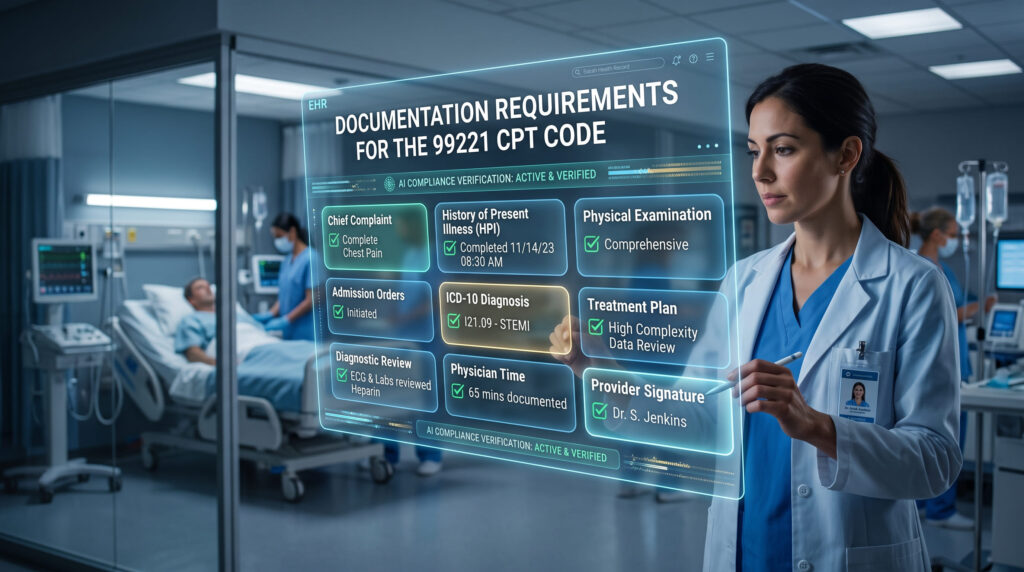
Proper documentation is essential when reporting the 99221 CPT Code. Medical records should clearly demonstrate the necessity for hospital admission and support the selected Evaluation and Management level.
Documentation should include:
- Patient demographics
- Admission date
- Chief complaint
- History of Present Illness (HPI)
- Relevant medical history
- Review of systems, when appropriate
- Physical examination
- Assessment
- Diagnosis
- Straightforward or low Medical Decision Making
- Diagnostic studies reviewed
- Treatment plan
- Medication management
- Physician orders
- Coordination of care
- Total physician time when billing by time
- Provider signature
Complete documentation helps improve coding accuracy while supporting payer compliance.
Medical Decision Making Requirements
The 99221 CPT Code requires straightforward or low Medical Decision Making (MDM) according to current CPT guidelines.
Medical Decision Making generally considers three components:
Number and Complexity of Problems
The physician evaluates one or more acute or chronic medical conditions requiring inpatient management.
Amount and Complexity of Data Reviewed
The provider may review laboratory results, imaging studies, previous medical records, diagnostic reports, and other clinical information relevant to the patient’s condition.
Risk of Complications and Management
The patient generally presents a low level of risk, requiring appropriate inpatient observation, medication management, diagnostic evaluation, or continued monitoring.
All three elements should be documented sufficiently to support the reported 99221 CPT Code.

Common Documentation Errors That Cause Claim Denials
Incomplete or inaccurate documentation is one of the primary reasons 99221 CPT Code claims are denied.
Common documentation errors include:
- Missing admission documentation
- Unsupported medical necessity
- Incomplete History of Present Illness
- Insufficient Medical Decision Making
- Missing physician assessment
- Incomplete treatment plan
- Incorrect diagnosis coding
- Missing physician signature
- Failure to document total physician time when billing by time
- Inadequate supporting clinical records
- Copy-and-paste documentation without encounter-specific updates
- Failure to comply with payer documentation guidelines
Routine provider education, internal documentation audits, and certified coding reviews help reduce denials while improving reimbursement accuracy.
Billing Guidelines for the 99221 CPT Code
Accurate billing of the 99221 CPT Code requires complete documentation, appropriate medical necessity, and compliance with Medicare and commercial payer Evaluation and Management (E/M) guidelines. Because the 99221 Code is used for an initial hospital inpatient or observation care encounter, insurance carriers closely review these claims to ensure the documented level of service supports the code reported.
Healthcare providers should follow these billing best practices:
- Confirm the patient qualifies for an initial inpatient or observation encounter.
- Ensure the patient admission is medically necessary.
- Verify documentation supports Straightforward or Low Medical Decision Making (MDM) or physician time requirements.
- Assign accurate ICD-10-CM diagnosis codes.
- Document all physician services performed.
- Include physician admission orders.
- Review laboratory, imaging, and diagnostic reports.
- Record the assessment and treatment plan.
- Verify insurance eligibility before admission whenever possible.
- Obtain prior authorization when required by the payer.
- Follow Medicare and commercial payer E/M guidelines.
- Review claims through claim-scrubbing software before submission.
- Submit claims electronically for faster reimbursement.
Following these billing guidelines helps improve clean claim rates, reduce denials, and accelerate reimbursement.
Common Billing Mistakes with the 99221 CPT Code
Improper reporting of the 99221 CPT Code frequently results in claim denials, downcoding, reimbursement delays, and payer audits. Healthcare organizations should educate physicians and coding staff to avoid these common billing errors.
Common mistakes include:
- Reporting the 99221 Code without supporting documentation.
- Selecting the wrong Evaluation and Management level.
- Insufficient Medical Decision Making documentation.
- Missing physician admission orders.
- Incomplete History of Present Illness (HPI).
- Unsupported medical necessity.
- Incorrect ICD-10 diagnosis coding.
- Missing provider signature.
- Failure to document physician time when billing by time.
- Billing observation services incorrectly.
- Duplicate claim submission.
- Failure to follow payer-specific inpatient billing guidelines.
Routine coding audits, physician education, and documentation reviews significantly reduce billing errors while improving reimbursement accuracy.

Reimbursement Tips for the 99221 CPT Code
Maximizing reimbursement for the 99221 Code requires complete documentation, accurate coding, and an efficient Revenue Cycle Management strategy.
Healthcare providers should:
- Maintain detailed physician documentation.
- Verify insurance eligibility before hospital admission.
- Confirm patient benefits and payer requirements.
- Assign accurate ICD-10-CM diagnosis codes.
- Review Medicare and commercial payer reimbursement policies regularly.
- Utilize certified medical coders.
- Conduct routine documentation audits.
- Submit clean electronic claims.
- Monitor claim status throughout the revenue cycle.
- Correct rejected claims immediately.
- Appeal denied claims using complete supporting documentation.
- Analyze reimbursement performance through Revenue Cycle Management reporting.
These best practices improve payment turnaround while reducing Accounts Receivable (AR) days.
How RevCore Medical Helps Healthcare Providers
At RevCore Medical, we help healthcare providers maximize reimbursement for the 99221 CPT Code through comprehensive Revenue Cycle Management solutions. Our experienced medical billing and coding professionals ensure every Evaluation and Management claim is accurately documented, coded, and submitted according to current payer requirements.
Our complete healthcare revenue cycle services include:
- Revenue Cycle Management (RCM)
- Medical Billing Services
- Medical Coding Services
- Insurance Eligibility Verification
- Provider Credentialing
- Prior Authorization
- Accounts Receivable (AR) Management
- Denial Management
- Medical Billing Audits
- Dental Billing
- No Cost Billing Analysis
Our certified professionals help hospitals, physician groups, hospitalists, outpatient clinics, specialty practices, and healthcare organizations improve coding accuracy, reduce denials, increase collections, and strengthen financial performance.
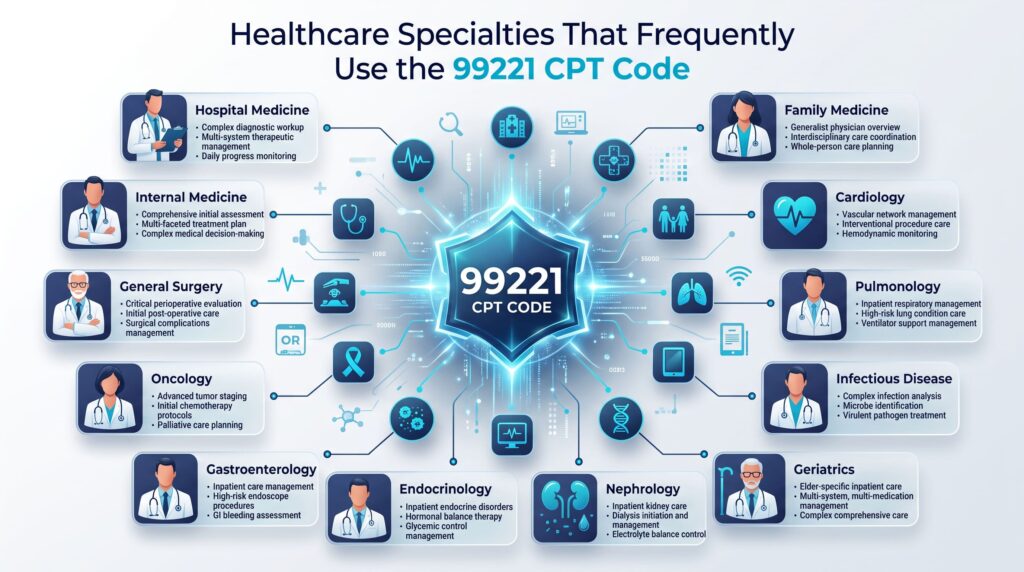
Healthcare Specialties That Frequently Use the 99221 CPT Code
The 99221 Code is commonly reported by physicians providing initial inpatient or observation care services.
Healthcare specialties that frequently report the 99221 CPT Code include:
- Hospital Medicine (Hospitalists)
- Internal Medicine
- Family Medicine
- Cardiology
- Pulmonology
- Infectious Disease
- Nephrology
- Endocrinology
- Gastroenterology
- Neurology
- Rheumatology
- Geriatric Medicine
- Oncology
- General Surgery
- Orthopedic Surgery
- Women’s Health
Proper documentation and accurate coding help these specialties maximize reimbursement while maintaining payer compliance.
Serving Healthcare Providers Throughout the United States
RevCore Medical proudly delivers professional Revenue Cycle Management, Medical Billing, Medical Coding, Insurance Eligibility Verification, Provider Credentialing, Prior Authorization, Accounts Receivable (AR) Management, Denial Management, Medical Billing Audits, Dental Billing, and No Cost Billing Analysis services to healthcare providers across the United States. We support hospitals, physician groups, hospitalists, outpatient clinics, ambulatory surgery centers, behavioral health providers, federally qualified health centers, and specialty healthcare organizations in New York City, Los Angeles, Chicago, Houston, Phoenix, Philadelphia, San Antonio, San Diego, Dallas, San Jose, Austin, Jacksonville, Fort Worth, Columbus, Charlotte, Indianapolis, Seattle, Denver, Boston, Nashville, Atlanta, Miami, Orlando, Tampa, Las Vegas, Sacramento, Minneapolis, Kansas City, Washington, D.C., Baltimore, Portland, Salt Lake City, Raleigh, Cleveland, Detroit, Cincinnati, St. Louis, Pittsburgh, and surrounding communities nationwide.
Frequently Asked Questions
What is the 99221 CPT Code used for?
The 99221 CPT Code is used to report an initial hospital inpatient or observation care Evaluation and Management (E/M) service requiring Straightforward or Low Medical Decision Making or the appropriate physician time.
Who can bill the 99221 CPT Code?
Physicians and qualified healthcare professionals responsible for the patient’s initial hospital or observation care may report the 99221 CPT Code when documentation supports the service.
Can the 99221 CPT Code be billed based on time?
Yes. The 99221 CPT Code may be selected based on approximately 40 minutes of total physician or qualified healthcare professional time on the date of the encounter when time controls code selection.
What documentation is required?
Documentation should include the admission reason, history of present illness, physical examination, assessment, diagnosis, medical decision making, treatment plan, physician orders, and physician signature.
Why are 99221 CPT Code claims denied?
Common denial reasons include insufficient documentation, unsupported medical necessity, incorrect diagnosis coding, missing physician orders, inadequate Medical Decision Making documentation, and incomplete admission records.
What level of Medical Decision Making is required?
The 99221 CPT Code requires Straightforward or Low Medical Decision Making (MDM) under current CPT Evaluation and Management guidelines.
Which specialties commonly report the 99221 CPT Code?
Hospital Medicine, Internal Medicine, Family Medicine, Cardiology, Pulmonology, Oncology, Infectious Disease, Gastroenterology, and several other specialties frequently report this code.
How can providers improve reimbursement?
Complete documentation, accurate diagnosis coding, insurance verification, certified medical coding, documentation audits, and clean claim submission significantly improve reimbursement.
How does RevCore Medical reduce denials?
RevCore Medical improves coding accuracy through certified Medical Coding, Revenue Cycle Management, documentation audits, denial management, payer compliance, and proactive claim monitoring.
Why outsource hospital billing to RevCore Medical?
Outsourcing helps healthcare organizations reduce administrative costs, improve coding accuracy, accelerate reimbursement, minimize denials, and maximize overall practice revenue.
Partner with RevCore Medical for Expert 99221 CPT Code Billing
Accurate reporting of the 99221 CPT Code is essential for timely reimbursement, regulatory compliance, and efficient hospital revenue cycle performance. Proper documentation, correct Medical Decision Making, accurate diagnosis coding, and compliance with payer guidelines all contribute to faster claim approvals and fewer denials.
At RevCore Medical, our certified billing and coding specialists provide complete Revenue Cycle Management solutions that help healthcare organizations optimize inpatient billing, improve coding accuracy, and maximize collections. From Medical Billing and Medical Coding to Eligibility Verification, Provider Credentialing, Prior Authorization, AR Management, Denial Management, and Medical Billing Audits, we provide dependable support tailored to your organization’s needs.
Get Your FREE No Cost Billing Analysis Today!
Why Choose RevCore Medical?
- ✔ Maximize 99221 CPT Code Reimbursement
- ✔ Reduce Insurance Claim Denials
- ✔ Improve Clean Claim Rates
- ✔ Accelerate Cash Flow
- ✔ Strengthen Your Revenue Cycle
- ✔ Ensure Coding Compliance
- ✔ Increase Healthcare Revenue
RevCore Medical
Your Trusted Revenue Cycle Management Partner for Healthcare Providers Across the United States.