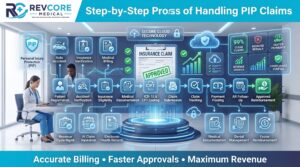
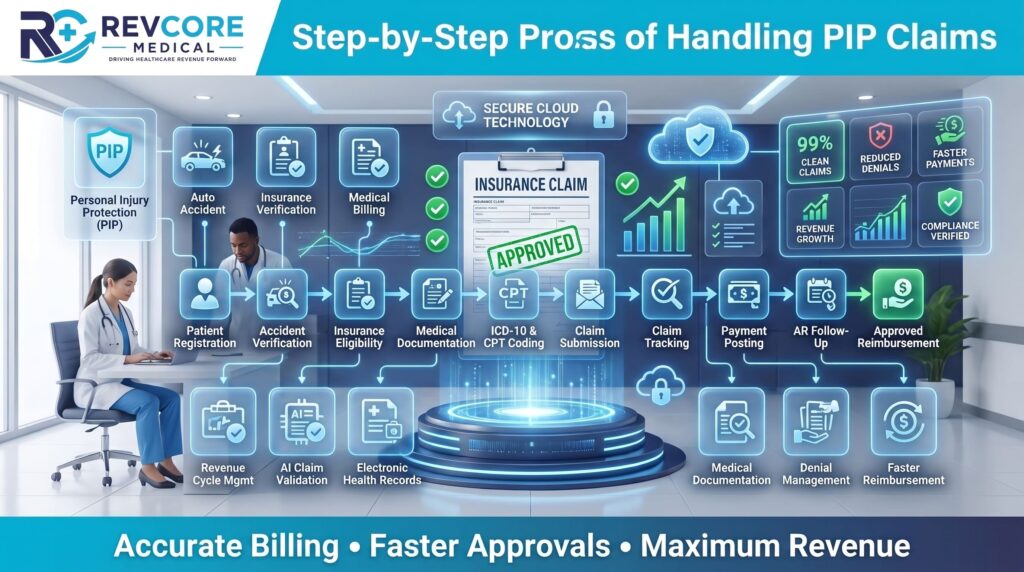
Successfully managing PIP Claims is essential for healthcare providers treating patients injured in motor vehicle accidents. Personal Injury Protection (PIP) insurance claims follow unique billing rules, documentation requirements, filing deadlines, and payer regulations that differ significantly from standard commercial insurance claims. Understanding the PIP Claims helps providers reduce claim denials, improve reimbursement rates, and maintain a healthy revenue cycle.
Healthcare organizations often experience delayed payments because of incomplete accident information, missing documentation, incorrect coding, expired filing deadlines, or failure to comply with state-specific PIP regulations. By implementing a structured PIP Claims, practices can improve operational efficiency while ensuring timely payment for medically necessary services.
At RevCore Medical, we specialize in helping healthcare providers throughout the United States optimize revenue through comprehensive Revenue Cycle Management (RCM), Medical Billing, Medical Coding, Insurance Eligibility Verification, Prior Authorization, Provider Credentialing, Accounts Receivable (AR) Management, Denial Management, Medical Billing Audits, Dental Billing, and No Cost Billing Analysis. Our experienced billing professionals manage every stage of the PIP Claims, allowing providers to focus on delivering exceptional patient care while maximizing reimbursement.
This comprehensive guide explains the complete PIP Claims, including documentation requirements, verification procedures, coding standards, billing workflows, and best practices for reducing claim denials.
What are PIP Claims in Medical Billing?
Personal Injury Protection (PIP) is an automobile insurance benefit that covers medical expenses resulting from injuries sustained in a motor vehicle accident, regardless of who caused the accident. In many no-fault insurance states, PIP coverage pays for necessary healthcare services before other insurance plans become responsible.
The PIP Claims involves collecting accident details, verifying insurance coverage, documenting medical necessity, assigning accurate diagnosis and procedure codes, submitting claims within required deadlines, monitoring claim status, and resolving payment issues efficiently.
Healthcare providers who understand the PIP Claims are better equipped to avoid administrative delays and secure timely reimbursement.
Why Proper PIP Claims Handling Matters
Managing the PIP Claims correctly benefits both providers and patients by improving financial performance and minimizing billing complications.
Key Benefits Include:
- Faster insurance claim processing
- Improved reimbursement rates
- Reduced claim denials
- Better cash flow
- Accurate medical documentation
- Compliance with payer requirements
- Lower administrative burden
- Stronger Revenue Cycle Management
- Fewer billing errors
- Improved patient satisfaction
- Reduced Accounts Receivable (AR) days
- Better financial stability for healthcare practices
A standardized PIP claims workflow also helps healthcare organizations maintain consistency across all accident-related cases.

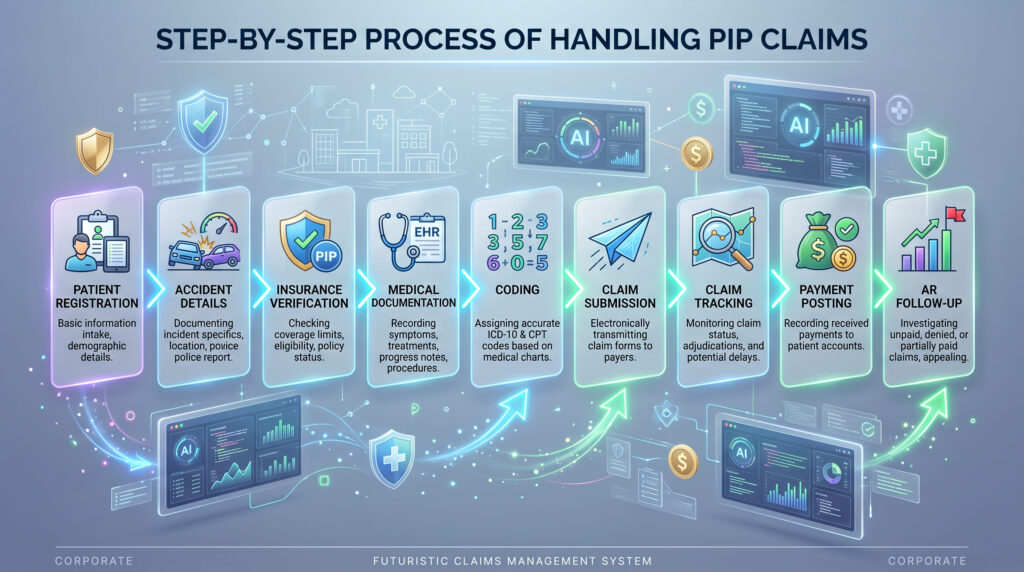
Step 1: Collect Complete Accident Information
The first step in the PIP Claims is gathering complete accident information during patient registration.
Essential information includes:
- Date and time of the accident
- Accident location
- Motor vehicle insurance company
- PIP policy number
- Claim number
- Adjuster’s contact information
- Police report number
- Attorney information (if applicable)
- Employer information (when relevant)
- Driver and passenger details
Collecting accurate information at the beginning helps prevent billing delays later in the claims process.
Step 2: Verify PIP Insurance Coverage
Insurance verification is one of the most important components of the PIP Claims.
Healthcare providers should verify:
- Active PIP coverage
- Policy effective dates
- Coverage limits
- Remaining benefits
- Deductibles
- Copayment requirements
- Authorization requirements
- Filing deadlines
- Medical necessity guidelines
- State-specific PIP regulations
Early verification reduces eligibility issues and minimizes claim denials.
Step 3: Obtain Required Authorizations and Documentation
Many PIP carriers require specific documentation before processing claims. During the PIP Claims, providers should obtain all required records promptly.
Documentation may include:
- Initial physician evaluation
- Medical history
- Physical examination
- Diagnostic imaging reports
- Treatment plans
- Referral documentation
- Prescription records
- Therapy evaluations
- Progress notes
- Operative reports (if applicable)
- Physician certifications
- Medical necessity documentation
Maintaining organized documentation supports faster claims processing and payer compliance.
Step 4: Assign Accurate Medical Codes
Accurate coding is critical in the PIP Claims. Every service provided must be supported by complete clinical documentation.
Medical coders should ensure:
- Correct ICD-10-CM diagnosis codes
- Accurate CPT procedure codes
- Appropriate HCPCS codes
- Modifier usage when required
- Medical necessity linkage
- Documentation consistency
- Coding compliance with payer policies
Proper coding reduces rejected claims and improves reimbursement accuracy.
Step 5: Prepare and Submit the PIP Claim
Once documentation and coding have been completed, the next phase of the PIP Claims is preparing a clean claim.
Before submission, billing teams should verify:
- Patient demographics
- Insurance information
- Accident details
- Diagnosis codes
- Procedure codes
- Provider credentials
- National Provider Identifier (NPI)
- Claim forms
- Required attachments
- Medical records
- Supporting documentation
- Electronic claim formatting
Submitting complete and accurate claims significantly increases first-pass payment rates while reducing administrative rework.
Step 6: Track the Claim After Submission
Submitting the claim is not the final stage in the PIP Claims. Continuous claim tracking is essential to ensure timely processing and payment.
Healthcare billing teams should regularly monitor:
- Claim acceptance status
- Insurance acknowledgment reports
- Pending documentation requests
- Claim processing updates
- Payment timelines
- Claim edits
- Rejected claims
- Denied claims
- Outstanding balances
- Appeals status
Using claim tracking software and proactive follow-up helps identify issues before they delay reimbursement.
Step 7: Respond Promptly to Insurance Requests
PIP insurance carriers frequently request additional documentation before approving payment. Responding quickly is a critical part of the PIP Claims.
Common requests include:
- Medical records
- Progress notes
- Diagnostic reports
- Treatment plans
- Physician certifications
- Itemized billing statements
- Referral documentation
- Operative reports
- Imaging reports
- Proof of medical necessity
Timely responses reduce processing delays and improve payment turnaround.
Step 8: Manage Claim Denials and Appeals
Even well-prepared claims may occasionally be denied. An organized denial management strategy is a vital component of the PIP Claims.
Common denial reasons include:
- Incorrect insurance information
- Missing accident details
- Incomplete documentation
- Coding errors
- Duplicate billing
- Expired filing deadlines
- Missing physician signatures
- Lack of medical necessity
- Authorization issues
- Invalid policy information
Healthcare organizations should:
- Review the denial reason carefully.
- Correct billing errors.
- Submit additional documentation.
- File appeals within payer deadlines.
- Track appeal outcomes.
- Monitor recurring denial trends.
Effective denial management increases successful reimbursement while minimizing revenue loss.
Step 9: Post Payments Accurately
Accurate payment posting is another essential stage in the PIP Claims.
Billing professionals should verify:
- Allowed amounts
- Paid amounts
- Deductibles
- Copayments
- Coinsurance
- Remaining policy benefits
- Outstanding balances
- Adjustments
- Contractual write-offs
- Explanation of Benefits (EOB)
Proper payment posting improves financial reporting and Accounts Receivable management.
Step 10: Perform Ongoing Accounts Receivable Follow-Up
The final stage in the PIP Claims is proactive Accounts Receivable (AR) management.
Revenue cycle teams should:
- Monitor aging reports.
- Contact insurance adjusters.
- Resolve unpaid claims.
- Reconcile payments.
- Identify underpayments.
- Submit corrected claims when needed.
- Escalate unresolved claims.
- Track appeal deadlines.
- Maintain communication records.
- Analyze reimbursement performance.
Continuous AR follow-up improves cash flow and shortens reimbursement cycles.
Essential Documentation Checklist for PIP Claims
Successful execution of the PIP Claims depends on maintaining complete documentation throughout the patient’s course of treatment.
Healthcare providers should consistently retain:
- Patient registration forms
- Insurance verification records
- Accident reports
- Police reports (when available)
- Physician evaluation notes
- Progress notes
- Diagnostic reports
- Imaging results
- Treatment plans
- Therapy documentation
- Referral records
- Medical necessity documentation
- Billing records
- Claim submission confirmations
- Explanation of Benefits (EOBs)
- Payment records
- Appeal documentation
- Correspondence with insurance adjusters
Comprehensive documentation strengthens claim accuracy, supports reimbursement, and prepares healthcare organizations for audits or payer reviews.
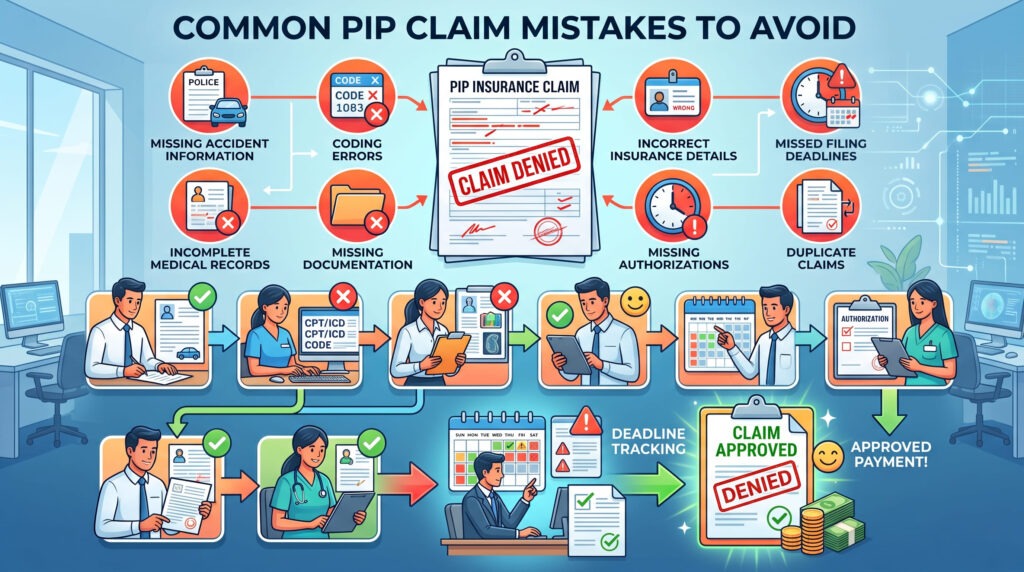
Common PIP Claim Mistakes to Avoid
Errors during the PIP Claims can lead to delayed payments and unnecessary denials.
Avoid these common mistakes:
- Missing accident information
- Incorrect PIP policy numbers
- Failure to verify coverage
- Missing claim numbers
- Incomplete physician documentation
- Incorrect ICD-10 diagnosis coding
- Incorrect CPT or HCPCS coding
- Missing modifiers
- Delayed claim submission
- Failure to obtain required authorizations
- Incomplete medical records
- Duplicate billing
- Missed appeal deadlines
- Poor communication with insurance adjusters
- Inaccurate payment posting
Routine internal audits help identify these issues before claims are submitted.
Best Practices to Maximize PIP Claim Reimbursement
Healthcare organizations can improve collections by following proven best practices throughout the PIP Claims.
Recommended strategies include:
- Verify insurance before treatment.
- Collect complete accident details.
- Maintain accurate documentation.
- Use certified medical coders.
- Follow state-specific PIP regulations.
- Submit clean claims electronically.
- Track claims daily.
- Respond quickly to payer requests.
- Perform regular coding audits.
- Monitor denial trends.
- Improve physician documentation.
- Utilize Revenue Cycle Management reporting.
- Outsource complex PIP billing when appropriate.
These practices improve reimbursement while reducing administrative costs.
How RevCore Medical Simplifies PIP Claims Management
At RevCore Medical, we help healthcare providers streamline the entire PIP Claims through comprehensive Revenue Cycle Management solutions. Our experienced billing specialists manage every stage of the PIP billing lifecycle, helping practices reduce denials, accelerate payments, and improve financial performance.
Our specialized services include:
- Revenue Cycle Management (RCM)
- Medical Billing Services
- Medical Coding Services
- PIP Claims Management
- Insurance Eligibility Verification
- Prior Authorization
- Provider Credentialing
- Accounts Receivable (AR) Management
- Denial Management
- Medical Billing Audits
- Dental Billing
- No Cost Billing Analysis
Our team works with physician practices, urgent care centers, orthopedic clinics, chiropractic offices, physical therapy providers, pain management specialists, hospitals, and multi-specialty medical groups across the United States.
Serving Healthcare Providers Across the United States
RevCore Medical proudly provides Revenue Cycle Management, Medical Billing, Medical Coding, PIP Claims Management, Insurance Eligibility Verification, Provider Credentialing, Prior Authorization, Accounts Receivable (AR) Management, Denial Management, Medical Billing Audits, Dental Billing, and No Cost Billing Analysis services to healthcare providers throughout the United States. We proudly support organizations in New York City, Los Angeles, Chicago, Houston, Phoenix, Philadelphia, San Antonio, San Diego, Dallas, San Jose, Austin, Jacksonville, Fort Worth, Columbus, Charlotte, Indianapolis, Seattle, Denver, Boston, Nashville, Atlanta, Miami, Orlando, Tampa, Las Vegas, Sacramento, Minneapolis, Kansas City, Washington, D.C., Baltimore, Portland, Salt Lake City, Raleigh, Cleveland, Detroit, Cincinnati, St. Louis, Pittsburgh, and surrounding communities nationwide.
Frequently Asked Questions
What is a PIP claim in medical billing?
A PIP claim is a medical insurance claim submitted under a patient’s Personal Injury Protection automobile insurance coverage for accident-related healthcare services.
What documents are required for PIP claims?
Typical documentation includes accident information, insurance details, physician evaluations, treatment notes, diagnostic reports, ICD-10 diagnosis codes, CPT codes, and supporting medical records.
Why are PIP claims denied?
Common reasons include incomplete documentation, incorrect insurance information, coding errors, missed filing deadlines, lack of medical necessity, and missing authorizations.
How can providers reduce PIP claim denials?
Providers should verify insurance coverage, maintain accurate documentation, submit clean claims, respond promptly to payer requests, and perform regular billing audits.
How long does PIP claim processing usually take?
Processing times vary by state and insurance carrier, but timely documentation and clean claim submission generally result in faster reimbursement.
Can PIP claims be appealed?
Yes. Denied PIP claims can usually be appealed by correcting claim errors and submitting additional supporting documentation within the payer’s deadline.
Which specialties commonly submit PIP claims?
Orthopedics, chiropractic, physical therapy, pain management, neurology, emergency medicine, primary care, and rehabilitation providers frequently bill PIP insurance.
Does RevCore Medical manage PIP billing?
Yes. RevCore Medical provides end-to-end PIP claims management, medical billing, coding, denial management, AR follow-up, and Revenue Cycle Management services.
How does outsourcing PIP billing benefit healthcare providers?
Outsourcing improves coding accuracy, reduces administrative workload, minimizes denials, speeds reimbursement, and enhances overall financial performance.
Why choose RevCore Medical?
RevCore Medical combines certified billing expertise, proactive denial management, advanced Revenue Cycle Management, and personalized support to help healthcare providers maximize reimbursement and strengthen cash flow.
Partner with RevCore Medical for Expert PIP Claims Management
Managing the PIP Claims requires precision, timely documentation, accurate coding, and consistent follow-up. A structured billing workflow helps reduce denials, improve reimbursement, and strengthen your practice’s financial performance.
At RevCore Medical, we provide complete Revenue Cycle Management solutions tailored to healthcare providers across the United States. From Medical Billing and Medical Coding to PIP Claims Management, Insurance Eligibility Verification, Prior Authorization, Provider Credentialing, Accounts Receivable Management, Denial Management, and Medical Billing Audits, our experienced team helps you optimize every stage of your revenue cycle.
Get Your FREE No Cost Billing Analysis Today!
Why Choose RevCore Medical?
- ✔ Specialized PIP Claims Billing Experts
- ✔ Faster Insurance Reimbursements
- ✔ Reduced Claim Denials
- ✔ Higher Clean Claim Rates
- ✔ Accurate Medical Coding
- ✔ Complete Revenue Cycle Management
- ✔ Improved Cash Flow & Practice Profitability
RevCore Medical
Your Trusted Medical Billing & Revenue Cycle Management Partner Across the United States.