
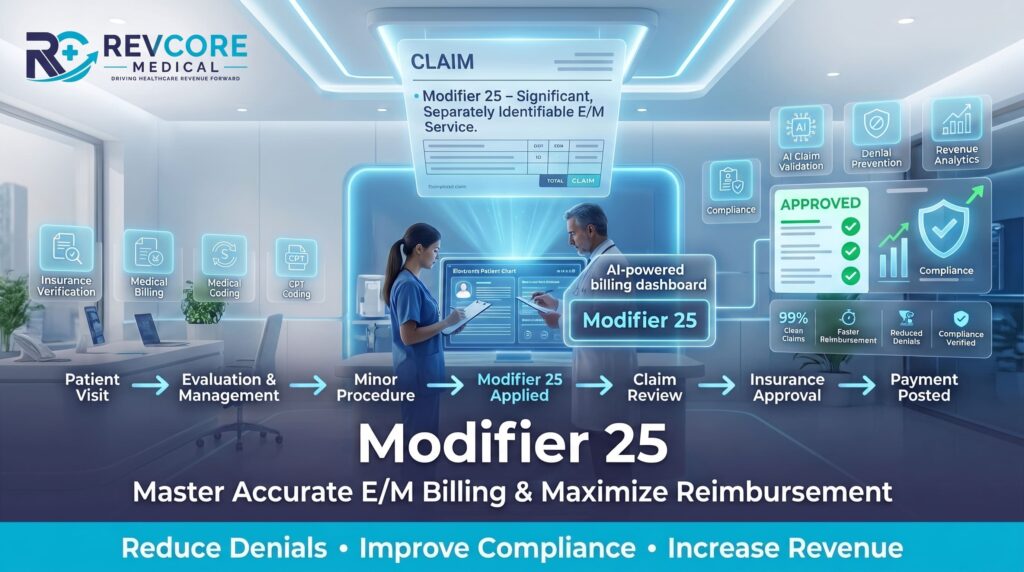
Correct modifier usage is one of the most important factors in successful medical billing, and Modifier 25 remains one of the most closely reviewed modifiers by Medicare and commercial insurance payers. When used appropriately, Modifier 25 allows healthcare providers to receive reimbursement for a significant, separately identifiable Evaluation and Management (E/M) service performed on the same day as another procedure or service. When used incorrectly, it can trigger claim denials, payment delays, audits, and compliance concerns.
Understanding Modifier 25 requires more than simply appending the modifier to an Evaluation and Management code. Providers must ensure that clinical documentation clearly demonstrates why the E/M service was distinct from the procedure performed. Proper documentation, accurate coding, and payer-specific compliance are essential to support reimbursement.
At RevCore Medical, we help healthcare organizations throughout the United States improve coding accuracy, reduce denials, and maximize collections through comprehensive Revenue Cycle Management, Medical Billing, Medical Coding, Eligibility Verification, Prior Authorization, Provider Credentialing, Accounts Receivable (AR) Management, Denial Management, Medical Billing Audits, Dental Billing, and No Cost Billing Analysis. Our experienced billing specialists work closely with physicians and healthcare facilities to ensure Modifier 25 is applied correctly while maintaining compliance with payer guidelines.
This comprehensive guide explains everything providers need to know about Modifier 25, including documentation requirements, billing guidelines, common mistakes, payer expectations, and proven strategies for improving reimbursement.
What is Modifier 25?
Modifier 25 is a CPT modifier appended to an Evaluation and Management (E/M) code to indicate that a physician or qualified healthcare professional performed a significant, separately identifiable E/M service on the same date as another procedure or service.
The modifier communicates to the payer that the patient’s evaluation extended beyond the routine pre-service and post-service work normally included in the procedure. Because many procedures already include a basic assessment, Modifier should only be reported when the documentation supports a medically necessary E/M service that is independent of the procedure itself.
Healthcare providers across primary care, urgent care, family medicine, internal medicine, dermatology, orthopedics, pain management, emergency medicine, and other specialties frequently use Modifier 25 when clinically appropriate.
Why Modifier 25 Matters in Medical Billing
Proper application of Modifier directly affects claim approval rates and overall revenue cycle performance. Insurance carriers carefully review claims containing this modifier because it impacts reimbursement for Evaluation and Management services performed alongside procedures.
Correct use of Modifier helps healthcare providers:
- Receive appropriate reimbursement for medically necessary E/M services
- Reduce preventable claim denials
- Improve clean claim rates
- Maintain coding compliance
- Strengthen documentation quality
- Increase billing accuracy
- Reduce payment delays
- Improve Revenue Cycle Management performance
- Lower audit risk
- Optimize financial outcomes
Practices that consistently apply Modifier 25 according to payer policies often experience fewer billing corrections and more predictable reimbursement.
When Should Modifier 25 Be Used?
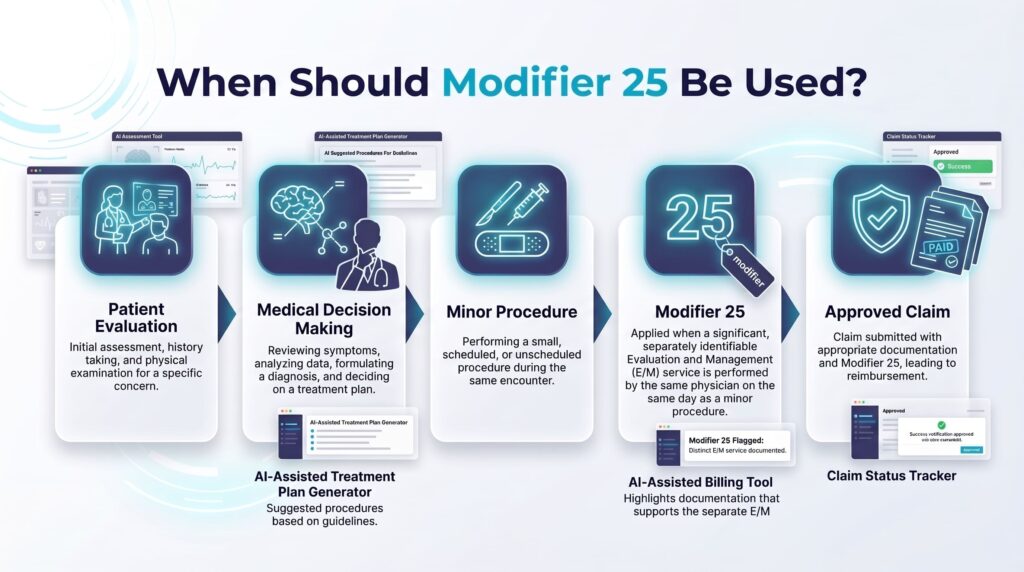
Modifier 25 should only be appended when all documentation requirements support a separately identifiable Evaluation and Management service performed on the same day as another procedure.
Situations that may justify Modifier include:
- Evaluation of a new complaint requiring medical decision-making
- Assessment of multiple medical conditions beyond the procedure
- Additional diagnostic evaluation unrelated to the scheduled procedure
- Review of laboratory or imaging results requiring independent clinical assessment
- Medication management requiring significant physician involvement
- Development or modification of a treatment plan
- Management of chronic diseases unrelated to the procedure
- Clinical decision-making requiring additional physician work
Medical necessity must always support the additional Evaluation and Management service.
Documentation Requirements for Modifier 25
Accurate documentation is the foundation of compliant Modifier 25 billing. Insurance carriers expect medical records to clearly distinguish the Evaluation and Management service from the procedure performed during the same encounter.
Documentation should include:
Patient History
- Chief complaint
- History of present illness
- Relevant medical history
- Medication review
- Review of systems
Physical Examination
- Comprehensive or problem-focused examination
- Clinical findings
- Assessment of affected body systems
- Objective observations
Medical Decision Making
- Problems evaluated
- Diagnostic testing reviewed
- Treatment decisions
- Risk assessment
- Differential diagnosis
- Care coordination
Treatment Documentation
- Separate procedure documentation
- Independent E/M documentation
- Medical necessity
- Physician signature
- Date of service
Every component should support the medical necessity of reporting Modifier independently from the procedure.
Services That Commonly Report Modifier 25
Several healthcare specialties routinely report Modifier 25 when documentation supports separate Evaluation and Management services.
Common specialties include:
- Family Medicine
- Internal Medicine
- Urgent Care
- Primary Care
- Emergency Medicine
- Dermatology
- Orthopedic Surgery
- General Surgery
- Cardiology
- Gastroenterology
- Neurology
- Rheumatology
- Endocrinolog
- Pediatrics
- Obstetrics and Gynecology
- Pain Management
- Physical Medicine and Rehabilitation
Although Modifier is frequently reported in these specialties, its use always depends on clinical documentation and payer requirements rather than specialty alone.
Modifier 25 vs. Other Common Medical Billing Modifiers
Confusion between Modifier 25 and other CPT modifiers is a common cause of billing errors. Understanding the differences helps prevent incorrect coding and unnecessary denials.
| Modifier | Purpose |
|---|---|
| Modifier 25 | Significant, separately identifiable E/M service on the same day as a procedure |
| Modifier 24 | Unrelated E/M service during a postoperative period |
| Modifier 57 | Decision for major surgery |
| Modifier 59 | Distinct procedural service |
| Modifier 51 | Multiple procedures performed during the same session |
| Modifier 79 | Unrelated procedure during postoperative period |
Each modifier serves a unique purpose, and selecting the correct one requires careful review of clinical documentation and payer billing policies.
Common Procedures Frequently Reported with Modifier 25
Healthcare providers may appropriately append Modifier 25 to an Evaluation and Management service when it accompanies procedures such as:
- Skin lesion removal
- Joint injections
- Trigger point injections
- Laceration repair
- Incision and drainage
- Cryotherapy
- Biopsy procedures
- Wound care
- Vaccination administration
- Diagnostic testing
- Minor surgical procedures
- Office-based interventions
Documentation must demonstrate that the Evaluation and Management service was above and beyond the routine assessment included with the procedure.
Billing Guidelines for Modifier 25
Applying Modifier correctly requires consistent documentation, coding accuracy, and adherence to payer-specific billing policies. Since many insurance companies closely monitor claims containing Modifier, healthcare providers should establish standardized billing workflows to reduce denials and improve reimbursement.
When billing Modifier 25, providers should ensure:
- The Evaluation and Management (E/M) service is medically necessary.
- The E/M service is significant and separately identifiable from the procedure.
- Clinical documentation fully supports the E/M service.
- The correct E/M CPT code is selected.
- The procedure code is reported separately.
- Medical decision making supports the billed E/M level.
- Documentation clearly distinguishes the evaluation from the procedure.
- All payer-specific guidelines are followed.
- Claims are submitted within filing deadlines.
- Documentation is retained for future audits.
Healthcare organizations that consistently follow these guidelines experience stronger first-pass claim acceptance and improved reimbursement performance.
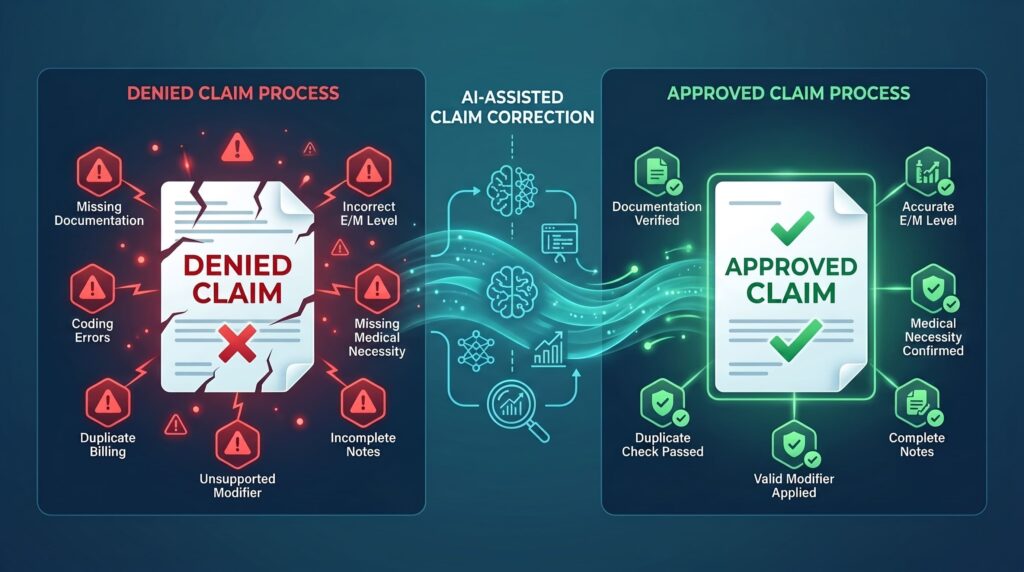
Common Reasons Modifier 25 Claims Are Denied
Although Modifier is widely accepted when properly documented, many claims are denied because providers fail to meet payer documentation requirements.
The most common denial reasons include:
- Insufficient documentation
- Medical necessity not established
- Routine pre-procedure assessment billed separately
- Incorrect E/M code selection
- Incomplete physician notes
- Missing patient history
- Unsupported medical decision making
- Duplicate billing
- Incorrect modifier assignment
- Payer-specific policy violations
- Inadequate documentation of separate services
- Coding inconsistencies
- Missing provider signatures
- Billing software errors
- Incorrect claim formatting
Understanding these denial patterns allows healthcare providers to improve coding accuracy before claims are submitted.
Best Practices for Accurate Modifier 25 Billing
Successful Modifier 25 reporting depends on a combination of physician documentation, coding expertise, and proactive claim management.
Healthcare providers should adopt these best practices:
Verify Medical Necessity
Every Evaluation and Management service billed with Modifier 25 should address medically necessary issues that extend beyond the procedure itself.
Improve Physician Documentation
Physicians should clearly document:
- Chief complaint
- Separate history
- Examination findings
- Medical decision making
- Treatment recommendations
- Assessment
- Follow-up plans
Clear documentation strengthens claim support during payer reviews.
Use Certified Medical Coders
Experienced coders understand CPT guidelines, payer policies, and modifier usage, reducing coding errors and improving claim accuracy.
Conduct Internal Billing Audits
Regular audits identify documentation gaps, coding inconsistencies, and recurring billing issues before they affect reimbursement.
Monitor Denial Trends
Tracking denial reasons allows practices to identify patterns and implement corrective actions that reduce future claim rejections.
Stay Updated on CPT Guidelines
Annual CPT updates and payer policy changes may affect Modifier 25 reporting requirements. Ongoing education ensures continued compliance.

Documentation Tips That Support Modifier 25
High-quality documentation remains the strongest defense against denials involving Modifier 25.
Medical records should demonstrate:
- Independent physician evaluation
- Separate clinical assessment
- Distinct medical decision making
- Additional physician work beyond the procedure
- Medical necessity
- Appropriate diagnosis coding
- Supporting laboratory or imaging review
- Treatment recommendations
- Follow-up planning
Documentation should allow an independent reviewer to clearly understand why the Evaluation and Management service deserves separate reimbursement.
How Modifier 25 Supports Revenue Cycle Performance
When reported correctly, Modifier 25 contributes to stronger financial outcomes by ensuring providers receive reimbursement for medically necessary Evaluation and Management services performed during procedural visits.
Benefits include:
- Improved clean claim rates
- Faster reimbursement
- Reduced payment delays
- Lower denial percentages
- Stronger documentation quality
- Increased coding accuracy
- Better compliance
- Improved physician productivity
- Enhanced Revenue Cycle Management
- More predictable cash flow
Healthcare organizations that implement standardized modifier policies often experience measurable improvements in billing efficiency.
How RevCore Medical Helps Healthcare Providers
Managing Modifier 25 requires expertise in medical coding, payer compliance, documentation review, and denial prevention. At RevCore Medical, our experienced billing specialists help healthcare providers optimize reimbursement while reducing administrative burden.
Our comprehensive solutions include:
- Revenue Cycle Management (RCM)
- Medical Billing Services
- Medical Coding Services
- Modifier 25 Documentation Review
- Eligibility Verification
- Prior Authorization
- Provider Credentialing
- Accounts Receivable (AR) Management
- Denial Management
- Medical Billing Audits
- Dental Billing
- No Cost Billing Analysis
Our team continuously monitors payer updates, coding guidelines, and reimbursement trends to ensure every claim meets industry standards.

Serving Healthcare Providers Across the United States
RevCore Medical proudly supports physicians, hospitals, ambulatory surgery centers, urgent care clinics, specialty practices, and multi-provider healthcare organizations throughout the United States. Our Revenue Cycle Management solutions are available in New York City, Los Angeles, Chicago, Houston, Phoenix, Philadelphia, San Antonio, San Diego, Dallas, Austin, Jacksonville, Fort Worth, Columbus, Charlotte, Indianapolis, Seattle, Denver, Boston, Nashville, Atlanta, Miami, Orlando, Tampa, Las Vegas, Sacramento, Minneapolis, Kansas City, Washington, D.C., Baltimore, Portland, Salt Lake City, Raleigh, Cleveland, Detroit, Cincinnati, St. Louis, Pittsburgh, and surrounding communities nationwide.
Whether your practice serves a large metropolitan area or a growing regional market, RevCore Medical delivers scalable medical billing solutions designed to maximize reimbursement and improve operational efficiency.
Frequently Asked Questions
What is Modifier 25 used for?
Modifier 25 indicates that a significant, separately identifiable Evaluation and Management (E/M) service was performed on the same day as another procedure by the same healthcare provider.
Can Modifier 25 be used with every procedure?
No. Modifier 25 should only be reported when documentation supports a medically necessary and distinct Evaluation and Management service beyond the routine work included in the procedure.
Does Modifier 25 increase reimbursement?
Modifier 25 allows reimbursement for a separately identifiable E/M service when supported by documentation. It does not automatically increase payment but ensures eligible services are compensated appropriately.
Why do insurance companies review Modifier 25 claims closely?
Because improper use of Modifier 25 has historically led to overbilling, many payers conduct additional reviews to confirm documentation supports separate reimbursement.
What documentation is required for Modifier 25?
Documentation should include a separate history, examination, medical decision making, physician assessment, treatment plan, and evidence of medical necessity distinct from the procedure.
Which specialties commonly report Modifier 25?
Family medicine, internal medicine, urgent care, emergency medicine, dermatology, orthopedics, pain management, pediatrics, cardiology, and many other specialties appropriately report Modifier 25 when documentation supports its use.
Can Modifier 25 reduce claim denials?
Yes. When applied correctly with complete documentation, Modifier 25 helps prevent unnecessary denials related to Evaluation and Management services.
How often should practices audit Modifier 25 claims?
Regular quarterly or monthly audits help identify documentation deficiencies, coding inconsistencies, and payer-specific issues before they impact revenue.
Does Medicare recognize Modifier 25?
Yes. Medicare accepts Modifier 25 when billing requirements and documentation standards are fully satisfied.
Why choose RevCore Medical for Modifier 25 billing support?
RevCore Medical combines experienced medical coders, certified billing professionals, proactive denial management, comprehensive Revenue Cycle Management, and continuous compliance monitoring to help healthcare providers maximize reimbursement while minimizing billing risk.
Maximize Your Revenue with RevCore Medical
Accurate reporting of Modifier 25 can significantly improve reimbursement, reduce claim denials, and strengthen your overall revenue cycle. However, achieving consistent results requires detailed documentation, precise coding, and a thorough understanding of evolving payer requirements.
At RevCore Medical, we help healthcare providers across the United States simplify complex billing challenges through expert Medical Billing, Medical Coding, Revenue Cycle Management, Eligibility Verification, Prior Authorization, Provider Credentialing, Accounts Receivable Management, Denial Management, Medical Billing Audits, Dental Billing, and No Cost Billing Analysis.
Get Your FREE No Cost Billing Analysis Today!
Partner with RevCore Medical to:
- ✔ Improve Modifier 25 claim accuracy
- ✔ Reduce costly denials and rework
- ✔ Increase first-pass claim acceptance
- ✔ Accelerate insurance reimbursements
- ✔ Optimize Revenue Cycle Management
- ✔ Strengthen compliance and documentation
- ✔ Maximize your practice’s financial performance
RevCore Medical – Your Trusted Medical Billing & Revenue Cycle Management Partner Across the United States.