

Introduction
Assignment of Benefits is an important part of the healthcare revenue cycle because it determines how insurance payments may be directed and processed after covered medical services are provided. When a patient authorizes an Assignment of Benefits, the healthcare provider may be permitted to receive applicable insurance payments directly rather than requiring the patient to receive the payment first and then pay the provider.
For medical practices, hospitals, specialty clinics, and other healthcare organizations, properly managing an Assignment of Benefits can simplify claim processing, payment posting, patient billing, and accounts receivable management.
However, an Assignment of Benefits is not simply a routine form placed in a patient’s registration packet. The authorization should be completed correctly, maintained with the appropriate patient records, and handled according to applicable payer requirements and organizational policies.
At RevCore Medical, we help healthcare providers improve their financial operations through comprehensive Revenue Cycle Management, Medical Billing and Coding, Eligibility Verification, Prior Authorization, Provider Credentialing, AR Management, Medical Billing Audits, Dental Billing, and No Cost Billing Analysis. These services support the complete billing lifecycle from patient registration and insurance verification through claims, payment posting, denial management, and AR follow-up.
What is an Assignment of Benefits?
An Assignment of Benefits is an authorization in which a patient directs an insurance company to make eligible benefit payments directly to a healthcare provider.
The authorization generally establishes that the provider can receive applicable insurance reimbursement for covered services provided to the patient.
The exact language, requirements, and effect of an Assignment of Benefits can vary depending on the insurance plan, payer rules, provider participation status, and applicable law.
An effective billing workflow should therefore treat the Assignment of Benefits as part of the broader patient financial and insurance administration process rather than as an isolated document.
Why is Assignment of Benefits Important?
An Assignment of Benefits can help create a more efficient payment process between the patient, healthcare provider, and insurance company.
For providers, proper handling may help:
- Direct eligible insurance payments to the appropriate provider
- Reduce unnecessary payment-routing complications
- Support accurate claim processing
- Improve payment reconciliation
- Simplify patient account management
- Strengthen documentation
- Support accounts receivable follow-up
- Reduce administrative delays
- Improve revenue cycle visibility
For patients, clearly explaining the authorization helps them understand how insurance payments are processed and how their remaining financial responsibility may be handled.
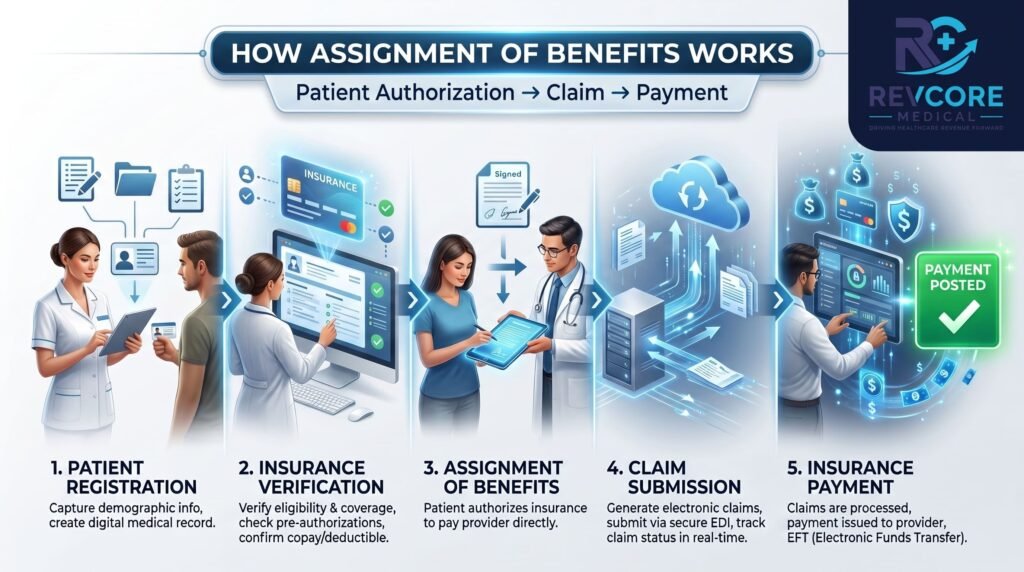
How Assignment of Benefits Works
The process generally begins during patient registration or insurance intake.
Step 1: Collect Patient Information
The practice gathers the patient’s demographic information, insurance details, identification numbers, subscriber information, and other required registration data.
Step 2: Review Insurance Coverage
Eligibility Verification helps confirm whether the patient’s coverage is active and identifies relevant benefit information.
Step 3: Obtain the Authorization
The patient reviews and signs the applicable Assignment of Benefits authorization when required.
Step 4: Document the Authorization
The completed authorization should be maintained according to the provider’s documentation and record-retention policies.
Step 5: Submit the Claim
The provider submits the medical claim to the appropriate insurance payer with accurate patient, provider, diagnosis, and procedure information.
Step 6: Receive and Post Payment
When the payer processes the claim, the payment and explanation of benefits are reviewed and posted to the patient’s account.
Step 7: Manage Remaining Balance
Any applicable deductible, copayment, coinsurance, or other patient responsibility is handled according to the patient’s benefits and the provider’s billing policies.
This workflow connects the Assignment of Benefits with several other revenue cycle functions.
Assignment of Benefits vs. Patient Financial Responsibility
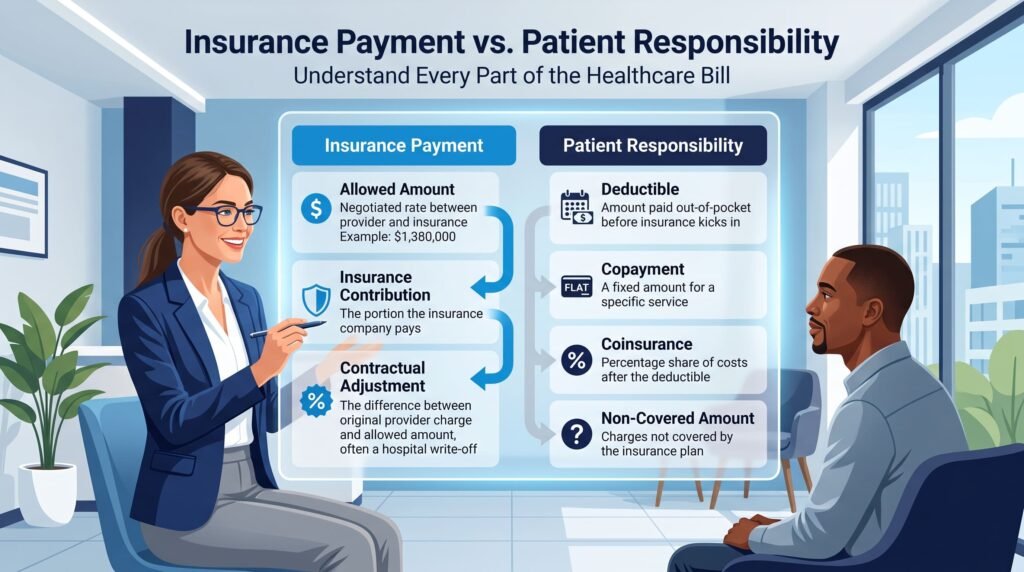
An important distinction is that an Assignment of Benefits does not automatically eliminate the patient’s financial responsibility.
A patient may still have responsibility for amounts such as:
- Deductibles
- Copayments
- Coinsurance
- Non-covered services
- Excluded benefits
- Amounts not payable under the applicable plan
The provider should therefore distinguish between the authorization to direct insurance benefits and the patient’s obligation for amounts that remain payable after insurance processing.
Clear financial communication can reduce confusion and improve patient account management.
Assignment of Benefits and Insurance Claims
Accurate claims processing is essential when an Assignment of Benefits is involved.
Claim information should be consistent with the patient’s insurance records and the provider’s documentation.
Important claim elements include:
- Patient identification
- Subscriber information
- Payer information
- Provider identification
- Tax identification information
- National Provider Identifier (NPI)
- Diagnosis codes
- CPT codes
- HCPCS codes when applicable
- Place of service
- Modifiers when applicable
- Date of service
- Charges
- Appropriate claim filing information
Errors in any of these areas can cause processing delays or denials regardless of whether an Assignment of Benefits has been completed.
Assignment of Benefits and the Explanation of Benefits
The Explanation of Benefits (EOB) is an important document for understanding how an insurance claim was adjudicated.
An EOB may provide information about:
- Amount billed
- Allowed amount
- Insurance payment
- Deductible
- Coinsurance
- Copayment
- Non-covered amount
- Contractual adjustment
- Patient responsibility
- Claim status
Healthcare billing teams should compare the EOB with the provider’s billing record to ensure payment posting is accurate.
If an insurance payment is directed to the provider under an Assignment of Benefits, accurate posting becomes particularly important because the payment must be matched to the appropriate patient account and claim.
Common Problems With Assignment of Benefits
Although an Assignment of Benefits can simplify reimbursement, administrative problems may occur when the authorization or related billing information is incomplete.
Common issues include:
Missing Authorization
The payer may require an authorization that is not present in the patient’s record.
Incorrect Patient Information
A mismatch in demographic or insurance information can interfere with claim processing.
Outdated Insurance Information
Patients may change insurance plans without updating their provider records.
Incorrect Payer Information
Claims sent to the wrong payer can result in delays and administrative rework.
Payment Posting Errors
Payments may be incorrectly allocated if the billing team does not reconcile the remittance carefully.
Patient Communication Gaps
Patients may misunderstand the difference between insurance payment authorization and their remaining financial responsibility.
Payer-Specific Requirements
Different insurance plans may have different administrative and reimbursement requirements.
Best Practices for Managing Assignment of Benefits
Healthcare organizations can strengthen their billing workflows by incorporating standardized procedures.
1. Verify Benefits Before the Visit
Eligibility Verification should be completed whenever appropriate to confirm active coverage and relevant benefit information.
2. Standardize Patient Registration
Use consistent registration procedures to reduce demographic and insurance errors.
3. Maintain Accurate Documentation
Store the applicable authorization and related documentation according to organizational policies and legal requirements.
4. Review Payer Requirements
Billing teams should understand the requirements applicable to each payer and plan.
5. Reconcile Insurance Payments
Payment posting should be compared against payer remittance information to identify discrepancies.
6. Monitor Unpaid Claims
Claims that remain unpaid should be tracked through the practice’s AR workflow.
7. Audit Billing Processes
Regular Medical Billing Audits can identify recurring documentation, coding, claim, and payment-posting problems.
8. Train Staff
Registration, billing, coding, and financial teams should understand their responsibilities within the patient payment workflow.

Assignment of Benefits and Revenue Cycle Management
The Assignment of Benefits is closely connected to Revenue Cycle Management because insurance authorization, claims, payment posting, and accounts receivable are interconnected.
RevCore Medical’s Revenue Cycle Management process covers patient registration, insurance verification, medical coding, claim submission, payment posting, denial management, and AR follow-up.
A coordinated approach can help healthcare organizations identify financial issues earlier instead of addressing problems only after a claim has been denied or a balance has become overdue.
How RevCore Medical Supports Better Billing Operations
RevCore Medical provides healthcare organizations with end-to-end billing support designed to improve financial performance and reduce administrative complexity. Its current service portfolio includes Revenue Cycle Management, Medical Billing and Coding, No Cost Billing Analysis, Provider Credentialing, Prior Authorization, Eligibility Verification, AR Management, Medical Billing Audit, and Dental Billing.
Revenue Cycle Management
RevCore Medical manages key stages of the revenue cycle, from patient registration through payment collection and AR follow-up.
Medical Billing and Coding
Accurate CPT, ICD-10, and HCPCS coding supports cleaner claims and more consistent reimbursement.
Eligibility Verification
Insurance eligibility verification helps practices identify coverage information before services are provided.
Prior Authorization
Prior authorization support helps providers manage payer requirements for services that require advance approval.
AR Management
AR specialists monitor outstanding balances and follow up on unpaid claims to improve collections.
Medical Billing Audit
Billing audits can identify revenue leakage, coding problems, documentation gaps, and recurring claim issues.
No Cost Billing Analysis
RevCore Medical offers a billing audit designed to identify revenue leaks, reduce denials, evaluate revenue cycle performance, and provide a customized improvement plan.
Assignment of Benefits and Claim Denial Prevention
A properly managed Assignment of Benefits is only one component of successful claim processing. Denial prevention requires attention to the entire claim lifecycle.
Providers should monitor:
- Patient eligibility
- Insurance information
- Authorization requirements
- Provider enrollment
- Coding accuracy
- Medical necessity
- Claim formatting
- Filing deadlines
- Payer edits
- Payment posting
- Denial codes
- AR aging
RevCore Medical’s billing workflow includes clean claim submission, claim monitoring, denial management, payment posting, and AR follow-up.

Major U.S. Service Areas
RevCore Medical supports healthcare providers throughout the United States. Its nationwide billing services can support practices in major healthcare markets including Phoenix, New York City, Los Angeles, Chicago, Houston, Dallas, Philadelphia, San Antonio, San Diego, Austin, Jacksonville, Fort Worth, Columbus, Charlotte, Indianapolis, Seattle, Denver, Boston, Atlanta, Miami, Orlando, Tampa, Las Vegas, Sacramento, Minneapolis, Kansas City, Washington, D.C., Baltimore, Portland, Cleveland, Detroit, Cincinnati, St. Louis, Pittsburgh, and surrounding communities.
RevCore Medical’s website identifies Phoenix, Arizona as its listed business location while describing its billing services as supporting healthcare providers across the United States.
Frequently Asked Questions
What is an Assignment of Benefits?
An Assignment of Benefits is an authorization that may allow a healthcare provider to receive applicable insurance payments directly from the payer for covered services.
Does Assignment of Benefits mean the patient does not owe anything?
No. The authorization does not automatically eliminate deductibles, copayments, coinsurance, or other amounts that may remain the patient’s responsibility.
Why is Assignment of Benefits important for medical billing?
It can simplify the flow of insurance payments and support more efficient claim processing, payment posting, and account reconciliation.
Is Assignment of Benefits required for every medical claim?
Requirements can vary by payer, plan, provider arrangement, and applicable rules. Practices should follow the requirements applicable to the specific claim.
Can a patient revoke an Assignment of Benefits?
The ability and process for changing or revoking an authorization can depend on the document, payer, provider policies, and applicable law. Patients should contact the provider or payer for specific guidance.
What happens after an insurance company processes the claim?
The payer issues claim adjudication information, commonly through an Explanation of Benefits or electronic remittance. The provider then posts the payment and determines any remaining balance.
How does Eligibility Verification help?
Eligibility Verification helps confirm active insurance coverage and relevant benefit information before services are provided, helping reduce avoidable billing problems.
How can Assignment of Benefits problems cause payment delays?
Missing documentation, incorrect payer information, patient-data errors, and inconsistent claim information can create administrative issues that delay processing.
Can RevCore Medical help with insurance claim management?
Yes. RevCore Medical provides Revenue Cycle Management, Medical Billing and Coding, Eligibility Verification, AR Management, Prior Authorization, Medical Billing Audits, and related services.
How can healthcare providers improve their billing performance?
Providers can improve performance by combining accurate registration, eligibility verification, coding, clean claim submission, payment reconciliation, denial management, and consistent AR follow-up.
Improve Your Healthcare Revenue Cycle With RevCore Medical
Effective management of Assignment of Benefits requires more than collecting a patient signature. It requires accurate patient information, appropriate insurance verification, compliant claim submission, accurate payment posting, and consistent accounts receivable follow-up.
RevCore Medical helps healthcare organizations manage these interconnected processes through comprehensive Revenue Cycle Management and specialized billing services.
Ready to identify billing inefficiencies and potential revenue leakage?
Get Your FREE No Cost Billing Analysis Today
RevCore Medical can help your practice:
- Improve billing accuracy
- Strengthen insurance verification
- Reduce avoidable claim denials
- Improve payment posting
- Manage outstanding AR
- Optimize revenue cycle performance
- Identify potential revenue leakage
RevCore Medical — Where Revenue Cycle Meets Precision and Performance.