Introduction
Understanding Revenue Cycle Management in Healthcare is essential for every medical practice, hospital, clinic, and healthcare provider operating in the United States. Revenue Cycle Management (RCM) is the financial backbone of healthcare organizations, ensuring that every service provided is properly documented, billed, and reimbursed.
At RevCore Medical, we specialize in helping healthcare providers streamline the entire process of what is Revenue Cycle Management in Healthcare by offering end-to-end solutions that improve revenue flow, reduce claim denials, and enhance operational efficiency.
In simple terms, Revenue Cycle Management refers to the entire financial process from patient appointment scheduling to final payment collection.
Understanding Revenue Cycle Management in Healthcare?
To clearly explain Revenue Cycle Management, it is important to understand that it is a multi-step process that ensures healthcare providers receive payment for services delivered.
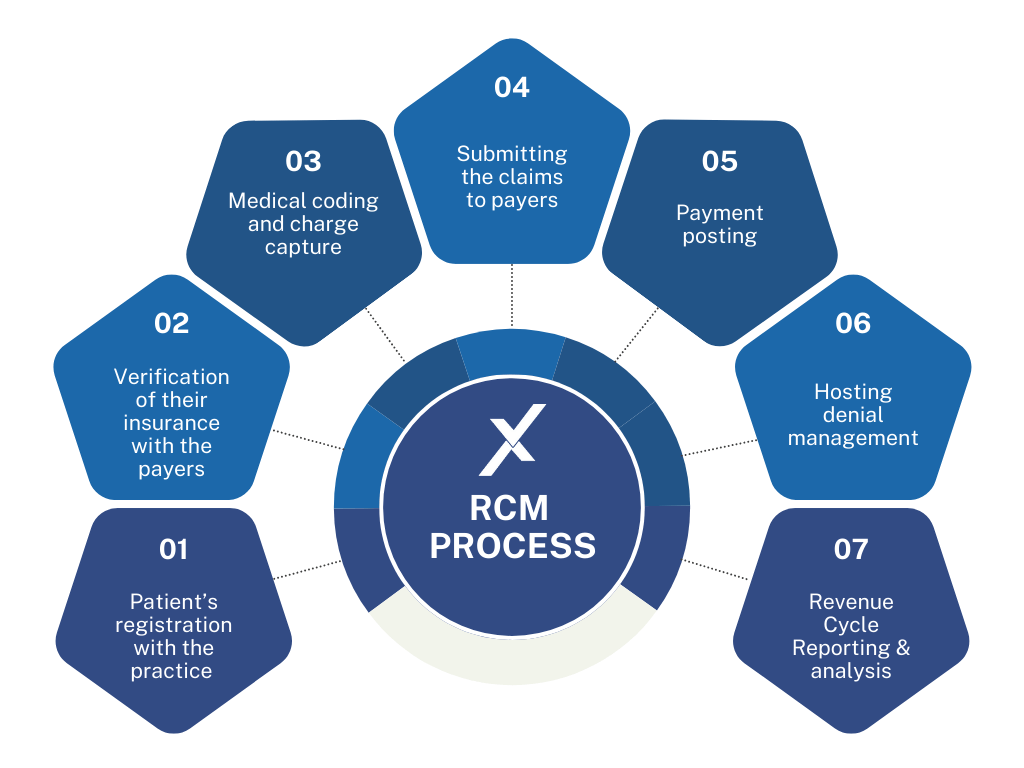
The process includes:
- Patient registration
- Insurance verification
- Medical coding
- Charge capture
- Claim submission
- Payment posting
- Denial management
- Accounts receivable follow-up
Each step in what is Revenue Cycle Management in Healthcare plays a critical role in ensuring financial stability for healthcare organizations.
Why is Revenue Cycle Management Important?
The importance of understanding Revenue Cycle Management lies in its direct impact on revenue generation and financial performance.
Key reasons include:
- Ensures timely reimbursements
- Reduces claim denials
- Improves cash flow
- Enhances billing accuracy
- Minimizes revenue leakage
- Strengthens financial transparency
- Supports compliance with healthcare regulations
Without proper understanding of Revenue Cycle Management, healthcare providers risk revenue loss and operational inefficiencies.
Steps Involved in Revenue Cycle Management in Healthcare?
The complete process of Revenue Cycle Management includes several critical stages:
1. Patient Registration
Accurate patient information is collected to begin the billing process.
2. Insurance Verification
Eligibility is confirmed to ensure coverage before treatment.
3. Medical Coding
Diagnoses and procedures are converted into standardized codes.
4. Charge Capture
Services provided are documented for billing purposes.
5. Claim Submission
Claims are submitted to insurance companies electronically.
6. Payment Posting
Payments received from insurers are recorded accurately.
7. Denial Management
Rejected claims are reviewed, corrected, and resubmitted.
8. Accounts Receivable Follow-up
Outstanding payments are tracked and collected.
Each of these stages defines Revenue Cycle Management in Healthcare in real-world operations.
Key Components of Revenue Cycle Management
To fully understand Revenue Cycle Management, we must explore its core components:
- Medical billing services
- Medical coding services
- Eligibility verification services
- Prior authorization services
- AR management services
- Provider credentialing services
- Medical billing audit services
- Claims management services
These components work together to ensure smooth financial operations.
Services Offered by RevCore Medical
At RevCore Medical, we provide complete support for organizations trying to optimize Revenue Cycle Management,
Revenue Cycle Management Services
We manage the entire financial workflow from start to finish.
Medical Billing Services
We ensure accurate claim submission and fast reimbursement.
Medical Coding Services
We provide ICD-10, CPT, and HCPCS coding accuracy.
AR Management Services
We recover outstanding claims and reduce AR days.
Eligibility Verification Services
We verify insurance coverage before treatment.
Prior Authorization Services
We manage approvals to prevent claim delays.
Provider Credentialing Services
We handle insurance enrollment and provider onboarding.
Medical Billing Audit Services
We identify revenue leakage and billing inefficiencies.
Dental Billing Services
We support dental practices with complete billing solutions.
These services collectively strengthen Revenue Cycle Management for providers across the USA.
Benefits of Revenue Cycle Management
Understanding what is Revenue Cycle Management in healthcare helps providers achieve key benefits:
- Increased revenue collection
- Reduced administrative burden
- Faster claim processing
- Improved financial accuracy
- Better patient billing transparency
- Reduced operational costs
- Stronger compliance adherence
Each benefit reinforces the importance of what is Revenue Cycle Management in Healthcare? for modern healthcare systems.
Challenges in Revenue Cycle Management
Even after understanding Revenue Cycle Management , providers face challenges such as:
- Claim denials
- Coding errors
- Insurance complexities
- Delayed reimbursements
- Lack of trained staff
- Compliance issues
- Inefficient billing systems
Addressing these challenges requires expert support like RevCore Medical.
Technology in Revenue Cycle Management
Modern systems have transformed what is Revenue Cycle Management in Healthcare? through:
- Automated billing systems
- AI-powered coding tools
- Electronic health records (EHR)
- Revenue analytics dashboards
- Claim tracking software
Technology improves efficiency and reduces manual errors.

Healthcare Specialties We Serve
Our expertise in what is Revenue Cycle Management in Healthcare? extends across:
- Family medicine
- Internal medicine
- Cardiology
- Orthopedics
- Dermatology
- Psychiatry
- Gastroenterology
- Radiology
- Pain management
- Dental practices
- Urgent care clinics
Each specialty requires customized RCM strategies.
Major Service Areas Across the United States
RevCore Medical supports healthcare providers nationwide while implementing what is Revenue Cycle Management in Healthcare? solutions in major cities such as New York City, Los Angeles, Chicago, Houston, Dallas, Phoenix, Philadelphia, San Antonio, San Diego, San Jose, Austin, Jacksonville, Fort Worth, Columbus, Charlotte, Indianapolis, Seattle, Denver, Boston, Nashville, Atlanta, Miami, Orlando, Tampa, Las Vegas, Sacramento, Minneapolis, Kansas City, and Washington, D.C. We also serve suburban and rural healthcare providers across the United States.
Why Choose RevCore Medical?
Healthcare providers trust us for what is Revenue Cycle Management in Healthcare? because:
- Experienced professionals
- End-to-end RCM solutions
- High claim approval rates
- Faster reimbursements
- Transparent reporting
- Scalable services
- Nationwide coverage
We ensure financial efficiency at every stage.
Frequently Asked Questions (FAQs)
What is Revenue Cycle Management in Healthcare?
It is the financial process of managing patient billing from registration to payment collection.
Why is RCM important?
It ensures timely reimbursement and reduces revenue loss.
Who uses Revenue Cycle Management?
Hospitals, clinics, and healthcare providers use it.
What services are included in RCM?
Billing, coding, AR management, credentialing, and verification.
Can RCM reduce claim denials?
Yes, significantly improves claim accuracy.
Is RCM only for hospitals?
No, it is used by all healthcare providers.
Does RevCore Medical provide RCM services?
Yes, complete end-to-end RCM solutions.
How does RCM improve revenue?
By optimizing billing and reducing delays.
Is RCM software-based?
Yes, modern RCM uses automation tools.
Do you serve nationwide?
Yes, across the United States.
CTA – Partner with RevCore Medical
If you are looking to improve financial performance and fully understand what is Revenue Cycle Management in Healthcare?, RevCore Medical is your trusted partner.
Request Your Free Consultation Today
- Improve Revenue Flow
- Reduce Claim Denials
- Optimize Billing Accuracy
- Strengthen Financial Stability
RevCore Medical — Experts in what is Revenue Cycle Management in Healthcare? Across the USA.